A Levels Physics (9702)•9702/12/O/N/21
A Levels Physics (9702) — 9702/12/O/N/21, Question 20
The total weight of a motorbike and rider is 1800 N. The motorbike travels in a straight line at constant speed up a hill at an angle of 30° to the horizontal. The useful output power of the motorbike is 3600 W. The total resistive force due to air resistance and friction on the motorbike is 240 N. What is the speed of the motorbike?
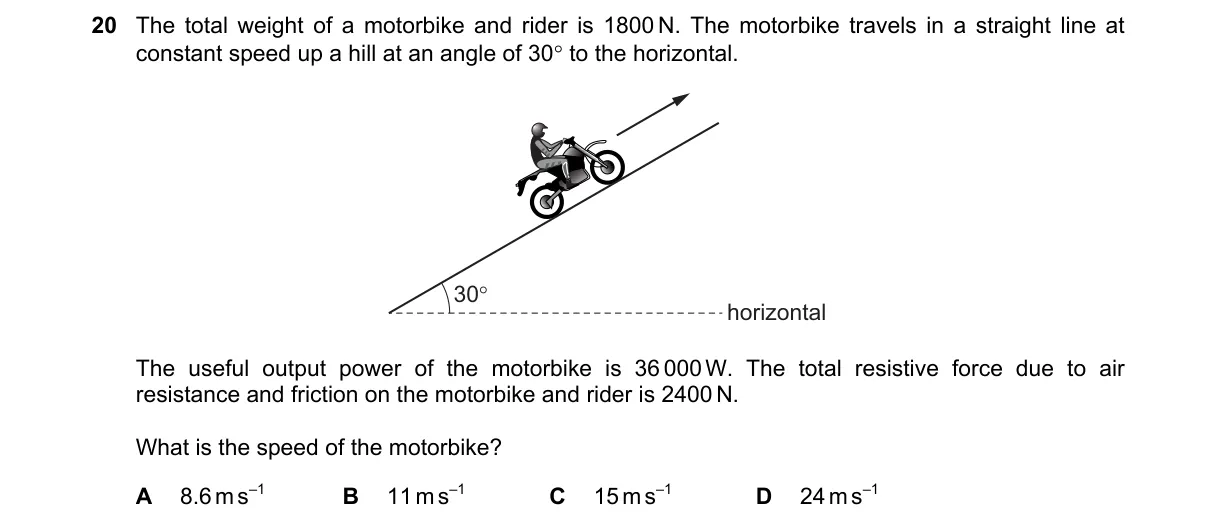
Answer choices
- A8.6 m/s
- B11 m/s
- C15 m/s
- D24 m/s
Explanation
Power equals total opposing force times speed for constant velocity
Steps:
- Component of weight parallel to incline: 1800 N × sin 30° = 900 N down the slope.
- Total opposing force: gravitational component + resistive force = 900 N + 240 N = 1140 N.
- Useful output power P = opposing force × speed, so speed v = P / opposing force = 3600 W / 1140 N = 11 m/s (rounded appropriately for options).
- Verify units: watts = newtons × meters/second, consistent.
Why B is correct:
- Follows the formula P = (mg sin θ + R) v, where solving for v gives 11 m/s directly from given values.
Why the others are wrong:
- A ignores part of gravitational component, underestimating speed.
- C neglects gravitational component entirely, overestimating speed for flat road.
- D uses only partial resistance, yielding unrealistically high speed.
Final answer: B
Topic: Gravitational potential energy and kinetic energy
Practice more A Levels Physics (9702) questions on mMCQ.me