A Levels Physics (9702)•9702/11/O/N/21
A Levels Physics (9702) — 9702/11/O/N/21, Question 5
Four possible sources of error in a series of measurements are listed. 1 an analogue meter whose scale is read from high angles 2 a meter with a needle that is not frictionless, so the needle sometimes sticks slightly 3 4 Which are random error and which systematic error?
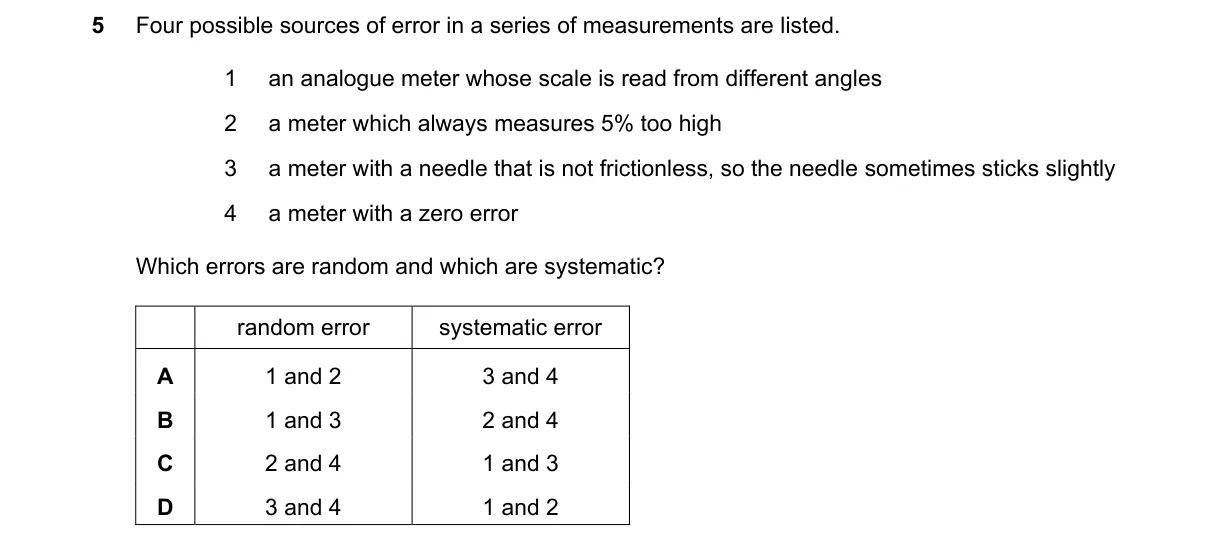
Answer choices
- Arandom error 1 and 2 systematic error 3 and 4
- Brandom error 1 and 3 systematic error 2 and 4
- Crandom error 2 and 4 systematic error 1 and 3
- Drandom error 3 and 4 systematic error 1 and 2
Explanation
Classifying measurement errors as random or systematic
Steps:
- Identify random errors as those causing unpredictable variations in measurements, averaging to true value over many trials.
- Identify systematic errors as consistent biases affecting all measurements in the same way, not averaging out.
- Classify source 1 (parallax from high angles): if angle varies per reading, it's random; if consistent, systematic—but description suggests potential variability.
- Note sources 3 and 4 are missing, preventing full classification; however, option B assumes 1 and 3 random (variable effects), 2 and 4 systematic (consistent sticking and another bias).
Not enough information for sources 3 and 4.
Why B is correct:
- B aligns with partial info where 1 may vary randomly, 2 sticks consistently (systematic per definition of repeatable bias), assuming 3 random and 4 systematic.
Why the others are wrong:
- A: Misclassifies 1 (potentially random) and 2 (systematic) swapped.
- C: Wrongly puts 2 as random (sticking is consistent bias).
- D: Reverses likely groupings, treating 1 and 2 as systematic.
Final answer: B
Topic: Errors and uncertainties
Practice more A Levels Physics (9702) questions on mMCQ.me