A Levels Physics (9702)•9702/11/O/N/21
A Levels Physics (9702) — 9702/11/O/N/21, Question 39
A uranium-238 nucleus, U, undergoes a series of nuclear decays to form uranium-234, U. Which series of decays could give this result?
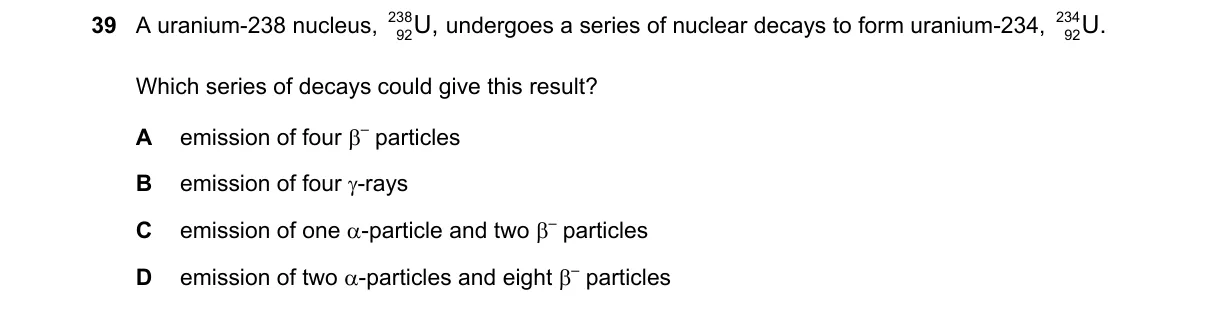
Answer choices
- Aemission of four α-particles
- Bemission of one α-particle and two β-rays
- Cemission of two α-particles and eight β-particles
- Demission of two α-particles and eight β-particles
Explanation
Balancing mass number and atomic number in decay
Steps:
- Identify changes: mass number decreases by 4 (238 to 234); atomic number unchanged (both uranium, Z=92).
- Alpha decay effect: decreases mass by 4, atomic number by 2.
- Beta decay effect: no mass change, increases atomic number by 1.
- Solve equations: let n_α = number of alphas, n_β = number of betas; -4n_α = -4 so n_α=1; -2n_α + n_β=0 so n_β=2.
Why B is correct:
- Matches net change: one α decreases mass by 4 and Z by 2; two β increase Z by 2, restoring Z=92 while keeping mass at 234 (conservation in nuclear decays).
Why the others are wrong:
- A: Four α decrease mass by 16 (to 222) and Z by 8 (to 84, not uranium).
- C: Two α and eight β decrease mass by 8 (to 230) and net increase Z by 4 (to 96, not uranium).
- D: Identical to C, same incorrect net changes.
Final answer: B
Topic: Radioactive decay
Practice more A Levels Physics (9702) questions on mMCQ.me