A Levels Physics (9702)•9702/11/O/N/21
A Levels Physics (9702) — 9702/11/O/N/21, Question 32
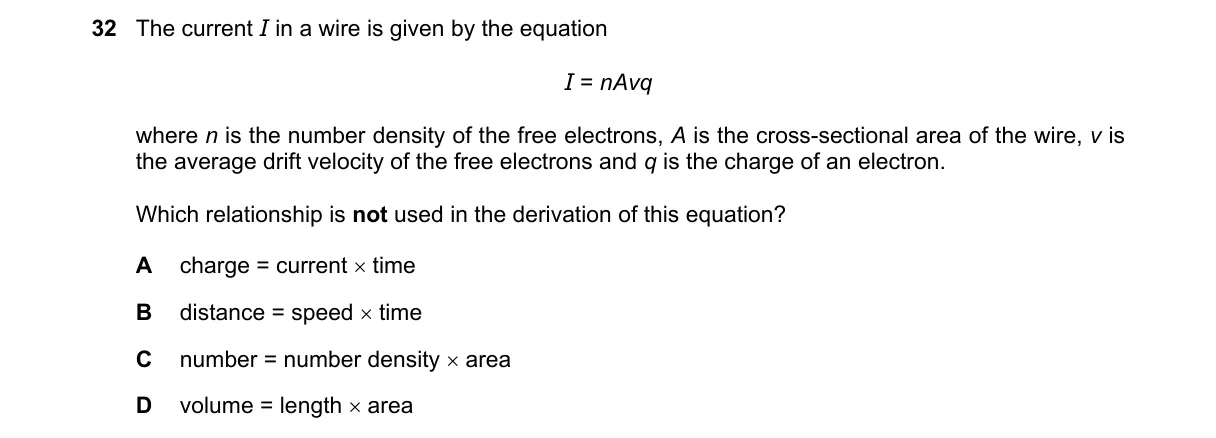
The current I in a wire is given by the equation I = nAvq where n is the number density of free electrons, A is the cross-sectional area of the wire, v is the average drift velocity of the free electrons and q the charge of an electron. Which relationship is not used in the derivation of this equation?
Answer choices
- Acharge = current × time
- Bdistance = speed × time
- Cnumber = number density × volume
- Dvolume = length × area
Explanation
Relations in Drift Current Derivation Steps:
- Current I equals total charge passing a cross-section per unit time.
- In time t, drifting electrons cover distance vt, forming a cylindrical volume of length vt and area A.
- Charge passing equals (electrons in that volume) times q, divided by t to get I.
- Simplifying yields I = nAvq, using charge-time, distance-speed-time, and volume-length-area relations.
Why C is correct:
- The derivation relies on electron flux rate (nAv electrons per second) times q, not total number of electrons in a static volume.
Why the others are wrong:
- A is used: Total charge Q = It, so I = Q/t.
- B is used: Drift length = vt for the segment of electrons passing in time t.
- D is used: Effective volume = A × (vt) containing passing electrons.
Final answer: C
Topic: Electric current
Practice more A Levels Physics (9702) questions on mMCQ.me