A Levels Physics (9702)•9702/11/O/N/21
A Levels Physics (9702) — 9702/11/O/N/21, Question 3
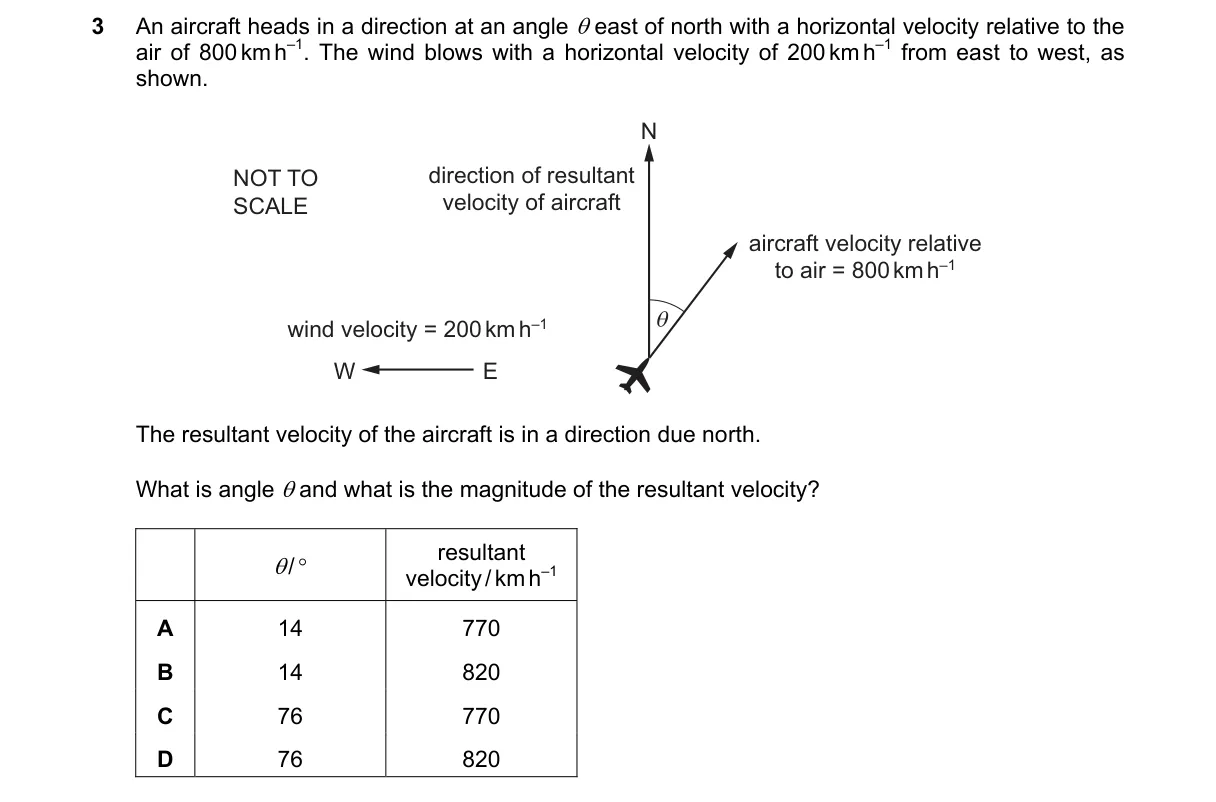
An aircraft heads in a direction at an angle θ east of north with a horizontal velocity relative to the air of 800 km h⁻¹. The wind blows with a horizontal velocity of 200 km h⁻¹ from east to west, as shown. NOT TO SCALE direction of resultant N velocity of aircraft aircraft velocity relative wind = 200 km⁻¹ to air = 800 km h⁻¹ W → E θ wind = 200 km h⁻¹ The resultant velocity of the aircraft is in a direction due north. What is θ and the magnitude of the resultant velocity?
Answer choices
- Aθ/° 14 resultant velocity / km h⁻¹ 770
- B14 820
- C76 770
- D76 820
Explanation
Vector Addition for Resultant Velocity
Steps:
- Aircraft velocity components: north = 800 cos θ km/h, east = 800 sin θ km/h.
- Wind velocity: west = 200 km/h (or -200 km/h east).
- For due north resultant, east component = 0: 800 sin θ - 200 = 0 → sin θ = 0.25 → θ ≈ 14°.
- Resultant magnitude = north component = 800 cos 14° ≈ 776 km/h ≈ 770 km/h.
Why A is correct:
- Satisfies vector addition rule where wind's westward component is exactly canceled by aircraft's eastward component for due north direction.
Why the others are wrong:
- B: Magnitude 820 km/h exceeds airspeed, impossible as wind reduces north component.
- C: θ=76° gives sin θ ≈0.97, east component ≈776 km/h, overshoots wind cancellation.
- D: Combines C's incorrect θ with B's impossible magnitude.
Final answer: A
Topic: Scalars and vectors
Practice more A Levels Physics (9702) questions on mMCQ.me