A Levels Physics (9702)•9702/11/O/N/21
A Levels Physics (9702) — 9702/11/O/N/21, Question 28
Light of wavelength λ is incident normally on two slits S1, S2, a small distance apart. Bright and dark fringes are observed on a screen a long distance away from the slits. The nth dark fringe from the central bright fringe is observed at point P on the screen. Which equation is correct for the nth dark fringe from the central bright fringe for all positive values of n?
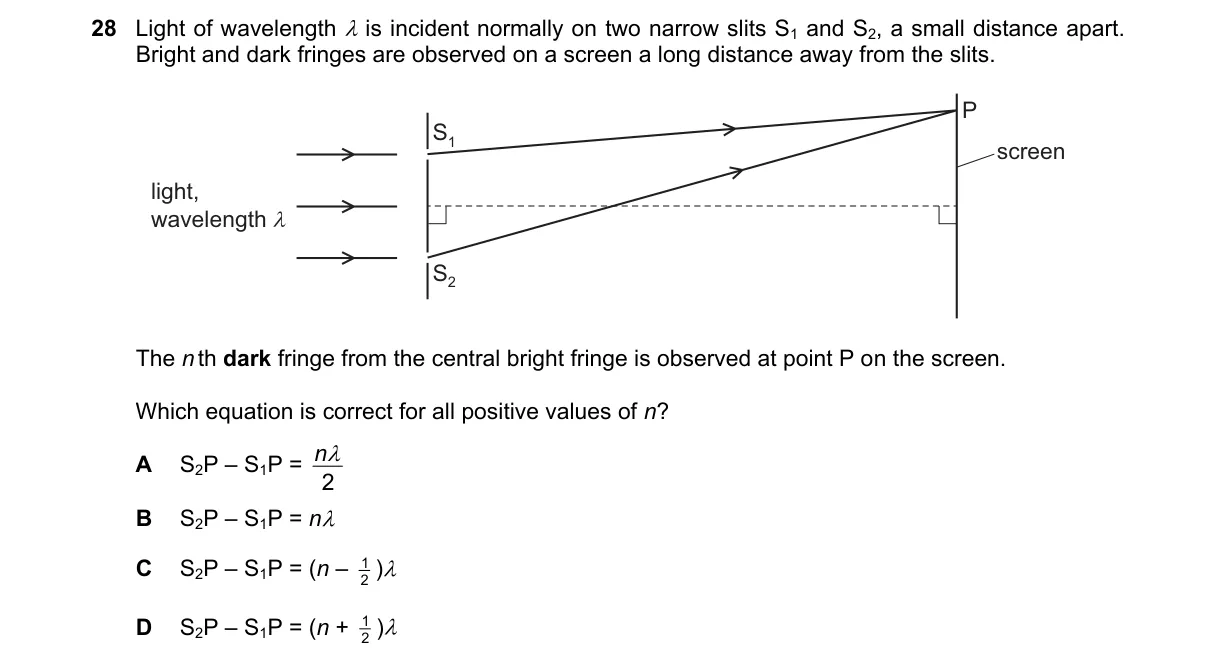
Answer choices
- ASP - S_P = nλ/2
- BSP - S_P = nλ
- CSP - S_P = (n - 1/2)λ
- DSP - S_P = (n + 1/2)λ
Explanation
Path difference for destructive interference
Steps:
- Central bright fringe occurs where path difference δ = 0.
- Dark fringes result from destructive interference when δ = (2n-1)λ/2 for n = 1, 2, 3, ...
- First dark fringe (n=1): δ = λ/2.
- General nth dark fringe: δ = (n - 1/2)λ.
Why C is correct:
- Matches the standard condition for destructive interference: path difference δ = (2n-1)λ/2 = (n - 1/2)λ, where n counts fringes from center.
Why the others are wrong:
- A: nλ/2 applies to bright fringes in some contexts but not dark; ignores odd multiples.
- B: nλ is for bright fringes (constructive interference).
- D: (n + 1/2)λ shifts numbering incorrectly; first dark would be 1.5λ instead of 0.5λ.
Final answer: C
Topic: Interference
Practice more A Levels Physics (9702) questions on mMCQ.me