A Levels Physics (9702)•9702/11/O/N/21
A Levels Physics (9702) — 9702/11/O/N/21, Question 23
A glass tube closed at one end and has a loudspeaker at the other. A stationary wave is formed with a node at the closed end of the tube when the sound has frequency f. There are no nodes at other end of the tube when the sound has frequency f. The frequency of the sound is then slowly increased. What is the frequency of the sound that produces the next stationary wave?
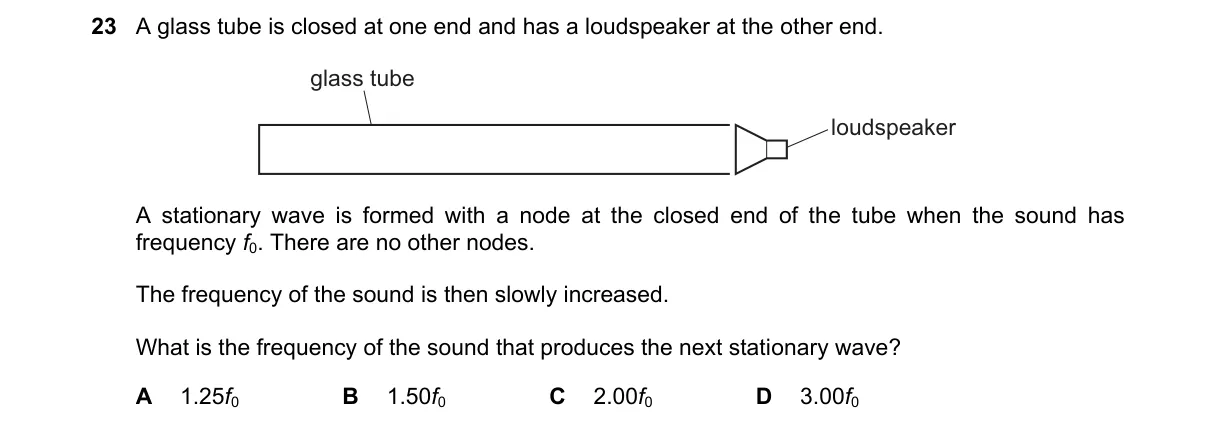
Answer choices
- A1.25f
- B1.50f
- C2.00f
- D3.00f
Explanation
Resonance in a closed-end tube
Steps:
- In a closed tube, the fundamental mode has a node at the closed end and antinode at the open end, so length L = λ/4 and f = v/(4L).
- The problem states a node at the closed end and no nodes at the open end for frequency f, confirming the fundamental mode.
- The next resonance occurs at the third harmonic, where L = 3λ/4, so frequency = 3v/(4L) = 3f.
- Even harmonics are absent in closed tubes due to the boundary conditions requiring odd quarter-wavelengths.
Why D is correct:
- The third harmonic frequency is exactly 3f, as derived from the resonance condition L = (2n+1)λ/4 for odd integers n.
Why the others are wrong:
- A: 1.25f does not match any harmonic multiple for a closed tube.
- B: 1.50f is not a resonance frequency; only odd multiples occur.
- C: 2.00f would be the first even harmonic, impossible in a closed tube.
Final answer: D
Topic: Stationary waves
Practice more A Levels Physics (9702) questions on mMCQ.me