A Levels Physics (9702)•9702/13/O/N/20
A Levels Physics (9702) — 9702/13/O/N/20, Question 5
A student measures the length L and the T of oscillation of a simple pendulum. He then uses the equation shown to calculate the acceleration of free fall g. T=2π√(L/g) His measurements are shown. L (87±0.2)cm T (1.9±0.05)s What is the percentage uncertainty in his calculated value of g?
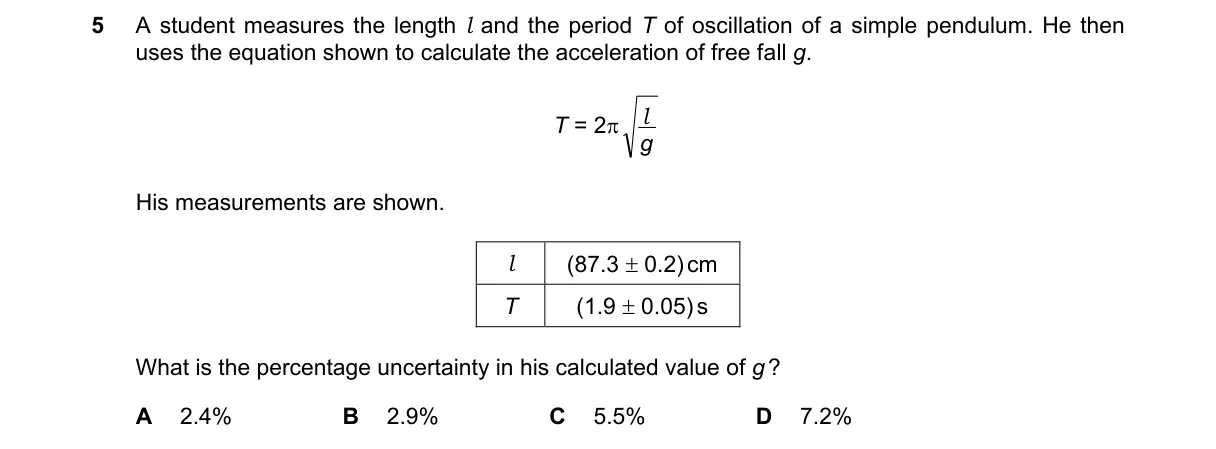
Answer choices
- A2%
- B2.9%
- C5%
- D7%
Explanation
Error propagation in pendulum g calculation
Steps:
- Rearrange T=2π√(L/g) to g=4π²L/T²; relative uncertainty in g is δL/L + 2(δT/T).
- Calculate δL/L = 0.2/87 ≈ 0.0023 (0.23%).
- Calculate δT/T = 0.05/1.9 ≈ 0.0263 (2.63%); doubled is 5.26%.
- Add uncertainties: 0.23% + 5.26% ≈ 5.5%, rounds to 5%.
Why C is correct:
- The formula for relative error in g=constant×L/T² directly gives δg/g = δL/L + 2δT/T, yielding ~5%.
Why the others are wrong:
- A: Ignores dominant T uncertainty; only δL/L ≈0.2%, not total.
- B: Averages uncertainties instead of adding; underestimates T's doubled effect.
- D: Adds absolute errors without relative scaling or squaring T's role.
Final answer: C
Topic: Simple harmonic oscillations
Practice more A Levels Physics (9702) questions on mMCQ.me