A Levels Physics (9702)•9702/13/O/N/20
A Levels Physics (9702) — 9702/13/O/N/20, Question 36
A cell is connected to a fixed resistor. Over a long period of time, the internal resistance of the cell increases. What is the effect of the increase in internal resistance on the electromotive force (e.m.f.) of the cell and the power dissipated in the fixed resistor?
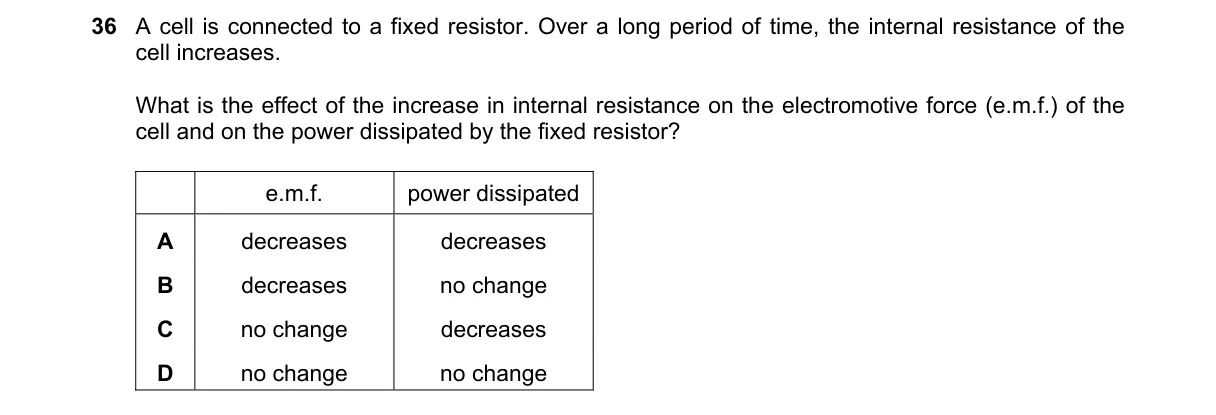
Answer choices
- Ae.m.f. decreases, power dissipated decreases
- Be.m.f. decreases, power dissipated no change
- Ce.m.f. no change, power dissipated no change
- De.m.f. no change, power dissipated no change
Explanation
Internal resistance affects current, not e.m.f.
Steps:
- Electromotive force (e.m.f.) is the cell's open-circuit potential difference, unchanged by internal resistance.
- Circuit current I = E / (R + r), where E is e.m.f., R is fixed external resistance, and r is internal resistance.
- As r increases, total resistance (R + r) rises, so I decreases.
- Power dissipated in fixed resistor P = I²R; with I decreasing, P decreases.
Why C is correct:
- e.m.f. E is intrinsic to the cell and unaffected by r (definition of e.m.f.); power P decreases per P = I²R formula as I falls.
Why the others are wrong:
- A: e.m.f. does not decrease; it remains constant.
- B: e.m.f. does not decrease; it remains constant.
- D: power dissipated decreases, not unchanged.
Final answer: C
Topic: Practical circuits
Practice more A Levels Physics (9702) questions on mMCQ.me