A Levels Physics (9702)•9702/13/O/N/20
A Levels Physics (9702) — 9702/13/O/N/20, Question 14
A glider is descending at constant speed at an angle of 15° to the horizontal. The diagram shows the directions of the lift, L, resistance R and weight W on the glider. Which vector triangle could represent the forces acting on the glider?
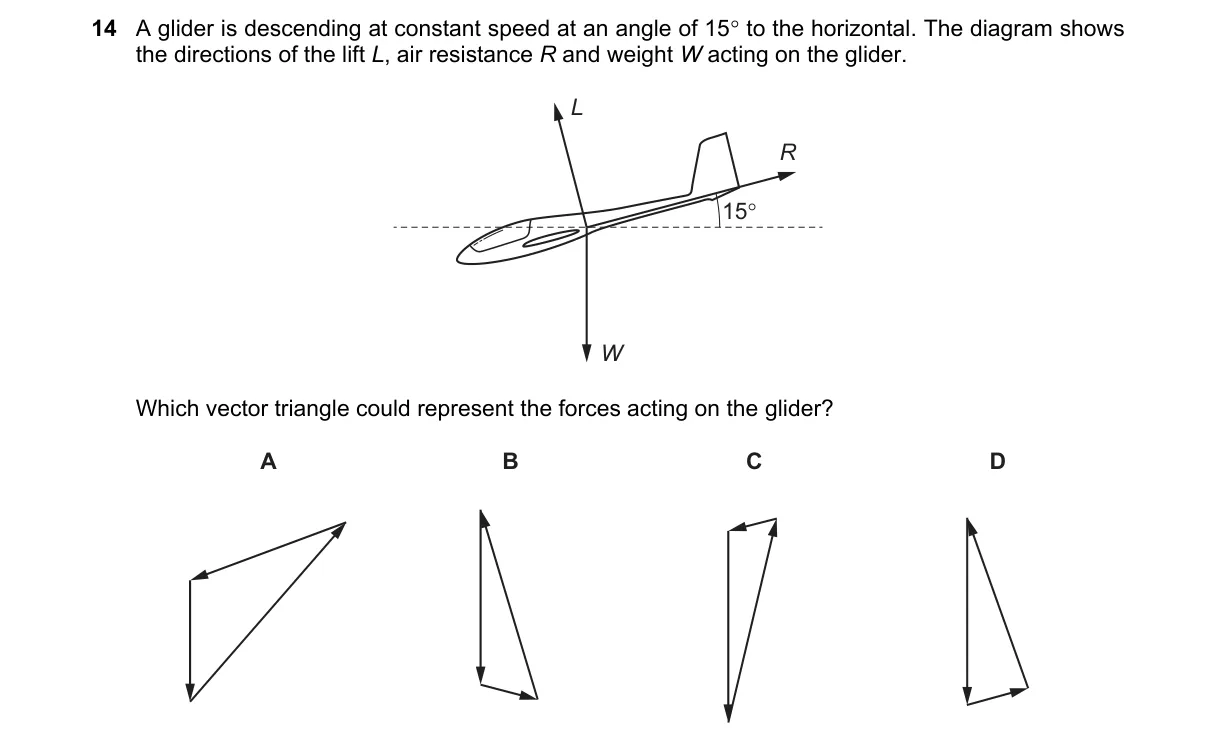
Answer choices
- AOption A
- BOption B
- COption C
- DOption D
Explanation
Forces balance in a vector triangle for steady descent
Steps:
- Constant speed means net force is zero, so L, R, and W form a closed vector triangle.
- W acts vertically downward.
- R acts opposite the flight path, upward at 15° to the horizontal.
- L acts perpendicular to the flight path, creating a 90° angle with R; the angle between W and R is 15°.
Why D is correct:
- D depicts a right triangle with 90° between L and R, and 15° between W and R, matching equilibrium where R = W sin 15° and L = W cos 15°.
Why the others are wrong:
- A: Shows acute angle between L and R, violating perpendicularity of lift to drag.
- B: Places W at wrong angle to R, not 15°.
- C: Incorrectly aligns L parallel to flight path, not perpendicular.
Final answer: D
Topic: Equilibrium of forces
Practice more A Levels Physics (9702) questions on mMCQ.me