A Levels Physics (9702)•9702/12/O/N/20
A Levels Physics (9702) — 9702/12/O/N/20, Question 39
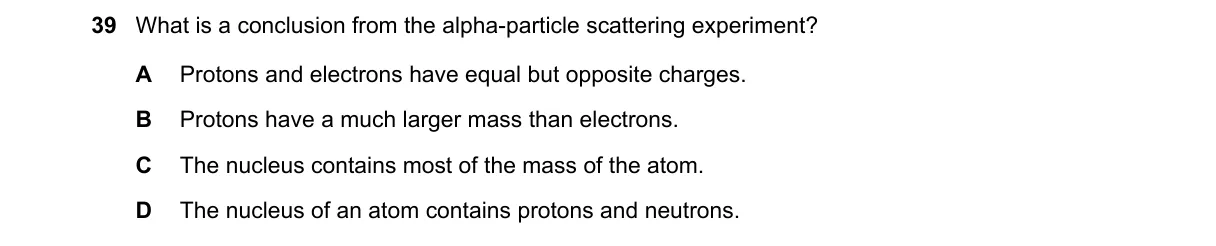
What is a conclusion from the alpha-particle scattering experiment?
Answer choices
- AProtons and electrons have equal but opposite charges.
- BProtons have much larger mass than electrons.
- CThe nucleus contains most of the mass of the atom.
- DThe nucleus of an atom contains protons and neutrons.
Explanation
Rutherford's Alpha-Particle Scattering Conclusions
Steps:
- Alpha particles (helium nuclei) were fired at thin gold foil.
- Most particles passed straight through, indicating atoms are mostly empty space.
- A few particles deflected at large angles, showing a concentrated positive mass in the atom.
- This led to the nuclear model where mass is centralized in a tiny nucleus.
Why C is correct:
- Large-angle deflections occur because alpha particles bounce off the dense, massive nucleus, per conservation of momentum, proving the nucleus holds most atomic mass.
Why the others are wrong:
- A: Charge equality known from electrolysis and Thomson's experiments, not scattering.
- B: Electron-proton mass ratio from J.J. Thomson's cathode ray work, predating scattering.
- D: Neutrons discovered later (1932) by Chadwick; scattering only revealed protons in nucleus.
Final answer: C
Topic: Atoms, nuclei and radiation
Practice more A Levels Physics (9702) questions on mMCQ.me