A Levels Physics (9702)•9702/12/O/N/20
A Levels Physics (9702) — 9702/12/O/N/20, Question 31
A molecule behaves as an electric dipole consisting of two equal point charges of opposite sign separated by a fixed distance. The dipole moves with constant horizontal velocity as it enters a vertical uniform electric field, as shown. What is the effect of the electric field on the velocity of the molecule?
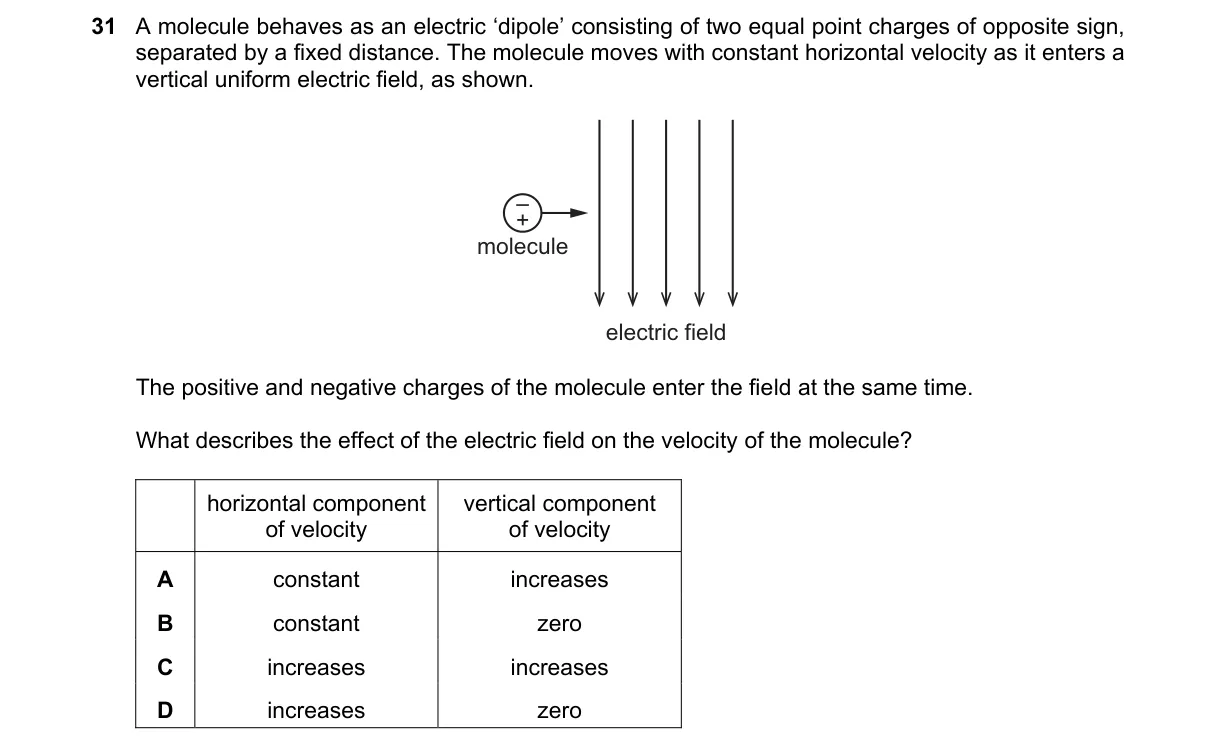
Answer choices
- Ahorizontal component of velocity constant, vertical component of velocity increases
- Bhorizontal component of velocity constant, vertical component of velocity zero
- Chorizontal component of velocity increases, vertical component of velocity zero
- Dhorizontal component of velocity increases, vertical component of velocity decreases
Explanation
Net force on dipole in uniform field is zero
Steps:
- The dipole has equal and opposite charges, so forces from the uniform vertical electric field are equal in magnitude but opposite in direction.
- These forces cancel, resulting in zero net force on the dipole.
- With no net force, the dipole's velocity remains unchanged in both components.
- Initial velocity is purely horizontal and constant, so no vertical component develops.
Why B is correct:
- In a uniform field, the net force on an ideal dipole is zero (from superposition of forces on charges), preserving constant horizontal velocity and zero vertical velocity.
Why the others are wrong:
- A: Vertical component does not increase, as no net vertical force acts.
- C: Horizontal component does not increase, as field is vertical and exerts no horizontal force.
- D: Neither component changes; horizontal stays constant, vertical remains zero.
Final answer: B
Topic: Uniform electric fields
Practice more A Levels Physics (9702) questions on mMCQ.me