A Levels Physics (9702)•9702/12/O/N/20
A Levels Physics (9702) — 9702/12/O/N/20, Question 28
A transmitting aerial sends out microwaves of wavelength 1.5 cm and radio waves of wavelength 15 km. The radio waves are reflected by the mountain but microwaves are not. transmitting aerial mountain receiving aerial NOT TO SCALE A receiving aerial must detect the radio waves but not the microwaves. What is the reason for this?
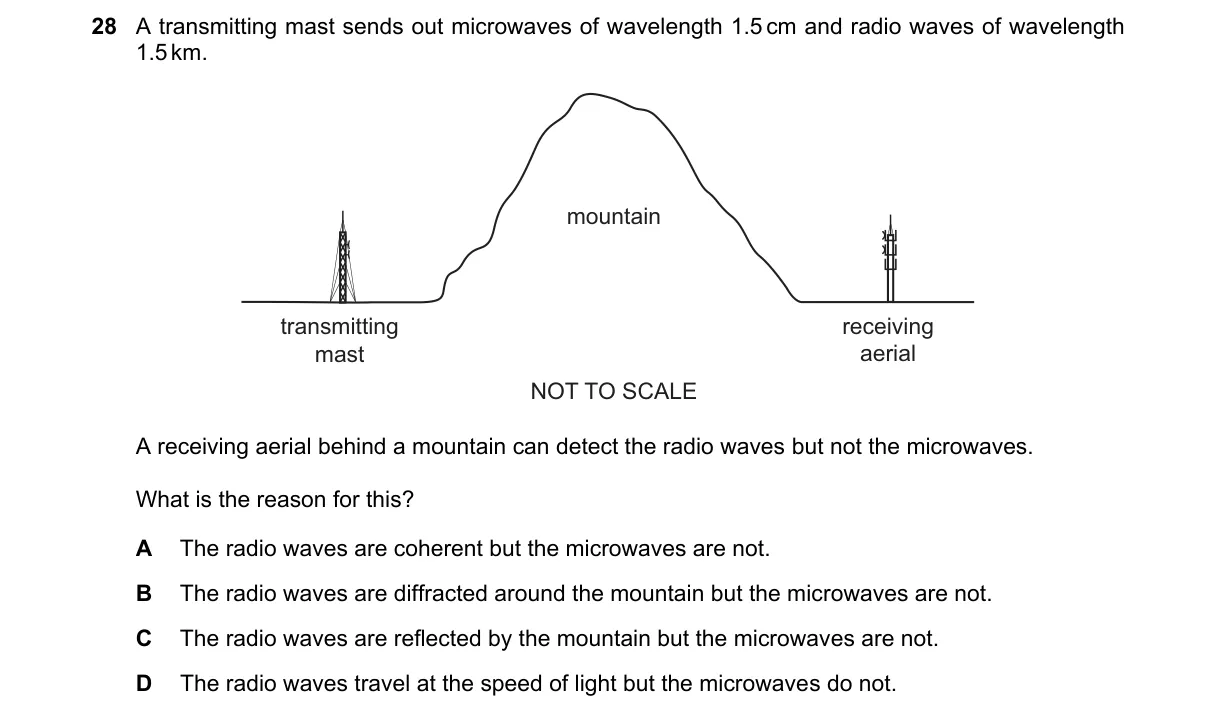
Answer choices
- AThe radio waves are coherent but the microwaves are not.
- BThe radio waves are diffracted around the mountain but the microwaves are not.
- CThe radio waves travel at the speed of light but the microwaves do not.
- DOption D
Explanation
Diffraction enables longer waves to bend around obstacles
Steps:
- Compare wavelengths: radio waves (15 km) are much longer than microwaves (1.5 cm).
- The mountain blocks the direct line-of-sight path between transmitter and receiver.
- Longer-wavelength radio waves diffract significantly around the mountain.
- Shorter-wavelength microwaves diffract minimally and cannot reach the receiver.
Why B is correct:
- Diffraction spreads waves around obstacles when wavelength is comparable to or larger than obstacle dimensions; radio waves' long wavelength allows bending around the mountain, unlike microwaves.
Why the others are wrong:
- A: Both waves from the aerial are coherent electromagnetic waves.
- C: All electromagnetic waves, including radio and microwaves, travel at the speed of light in vacuum.
Final answer: B
Topic: Diffraction
Practice more A Levels Physics (9702) questions on mMCQ.me