A Levels Physics (9702)•9702/12/O/N/20
A Levels Physics (9702) — 9702/12/O/N/20, Question 23
When sound travels through air, the air particles vibrate. A graph of displacement against time for a single air particle is shown. Which graph shows how the kinetic energy of the air particle varies with time?
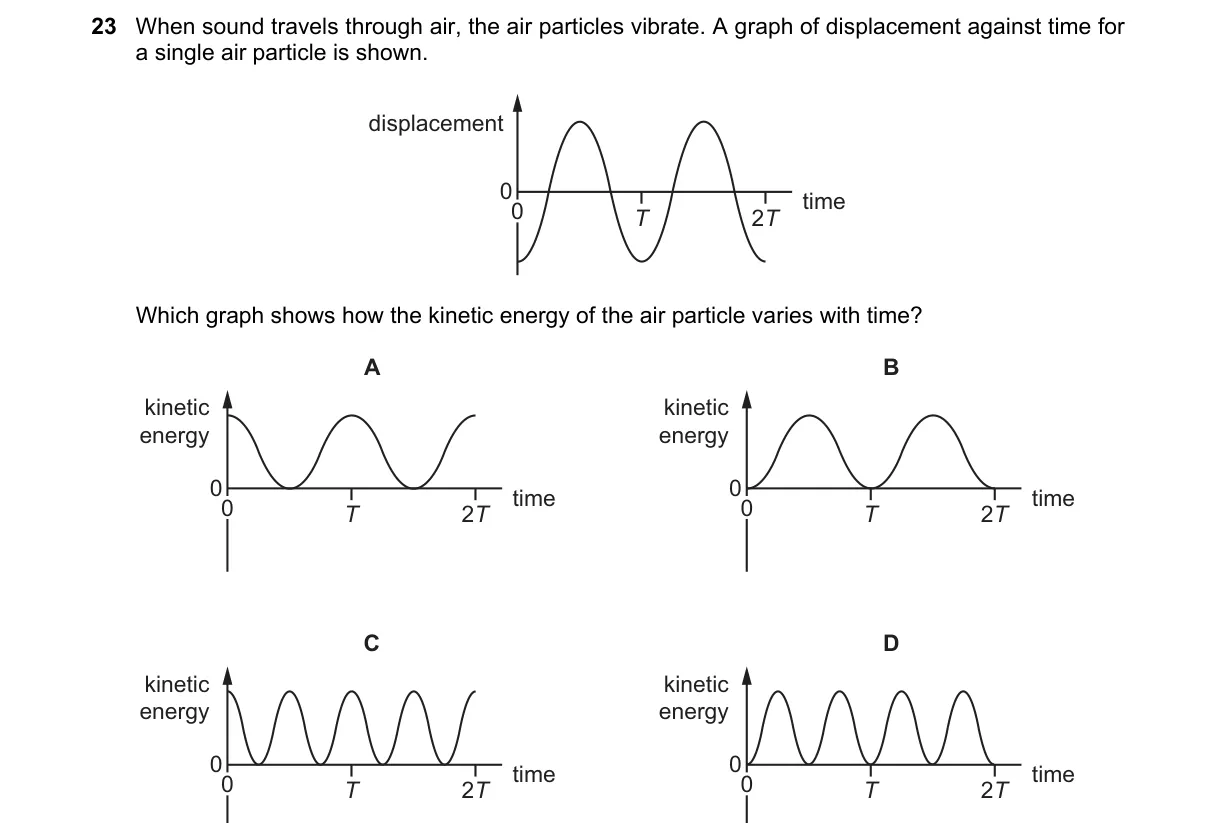
Answer choices
- AOption A
- BOption B
- COption C
- DOption D
Explanation
Kinetic energy proportional to squared velocity in oscillatory motion
Steps:
- Displacement-time graph is sinusoidal, representing simple harmonic motion of the air particle.
- Velocity is the derivative of displacement, yielding a cosine wave (positive and negative).
- Kinetic energy KE = ½ m v², so KE varies as the square of velocity, always non-negative.
- Squaring the velocity produces a waveform oscillating at twice the frequency of displacement, between zero and maximum.
Why D is correct:
- D depicts the squared cosine variation, directly following KE ∝ v² from Newton's laws of motion.
Why the others are wrong:
- A: Mirrors displacement, which includes negative values unlike energy.
- B: Resembles velocity, which oscillates through zero but goes negative.
- C: Shows constant or linear trend, ignoring oscillatory nature of v².
Final answer: D
Topic: Energy in simple harmonic motion
Practice more A Levels Physics (9702) questions on mMCQ.me