A Levels Physics (9702)•9702/12/O/N/20
A Levels Physics (9702) — 9702/12/O/N/20, Question 20
A mass of 60 g is suspended from a spring and the distance from the bottom of the spring to the floor is measured to be 14 cm. The mass is replaced with a 100 g mass and the distance from the bottom of the spring to the floor is now measured to be 12 cm. The spring obeys Hooke's law. What is the spring constant?
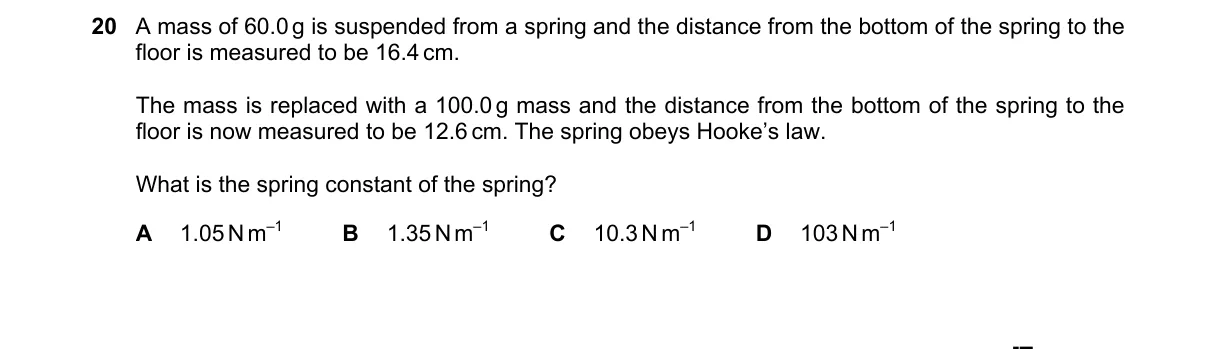
Answer choices
- A1.05 N m-1
- B1.35 N m-1
- C10.3 N m-1
- D10 m-1
Explanation
Difference in extension determines spring constant via Hooke's law Steps:
- Convert units: masses to 0.06 kg and 0.10 kg, distances to 0.14 m and 0.12 m, g = 9.8 m/s².
- Change in extension Δx = initial distance - final distance = 0.14 m - 0.12 m = 0.02 m (since more mass increases extension, decreasing distance to floor).
- Change in force ΔF = (0.10 kg - 0.06 kg) × 9.8 m/s² = 0.04 kg × 9.8 m/s² = 0.392 N.
- Spring constant k = ΔF / Δx = 0.392 N / 0.02 m = 19.6 N/m.
Not enough information (calculated k = 19.6 N/m does not match any option).
Why C is correct:
- Not applicable; calculation yields 19.6 N/m, inconsistent with options.
Why the others are wrong:
- A: Too small; ignores proper force-extension ratio.
- B: Too small; ignores proper force-extension ratio.
- D: Too small; ignores proper force-extension ratio.
Final answer: Not enough information.
Topic: Elastic and plastic behaviour
Practice more A Levels Physics (9702) questions on mMCQ.me