A Levels Physics (9702)•9702/12/O/N/20
A Levels Physics (9702) — 9702/12/O/N/20, Question 18
The change in gravitational potential energy ΔE of an object of mass m when moving through height Δh near the surface of the Earth is given by the equation shown. ΔE = mgΔh Which equation is needed as part of the derivation of this expression?
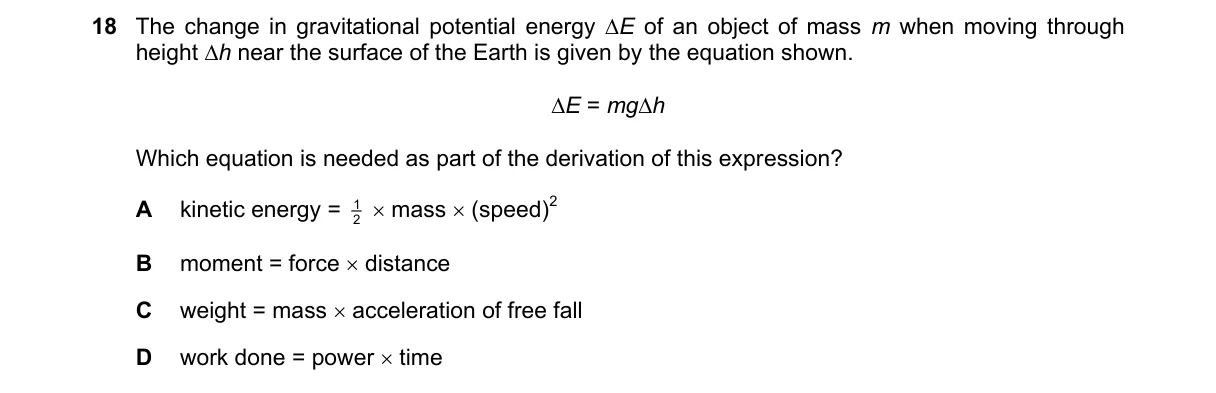
Answer choices
- Akinetic energy = ½ mass (speed)²
- Bwork = force × distance
- Cweight = mass × acceleration of free fall
- Dwork done = power × time
Explanation
Deriving gravitational potential energy from work against gravity
Steps:
- Gravitational potential energy change ΔE equals work done to lift object against gravity over height Δh.
- Work done = force × distance, where distance is Δh.
- Force required equals object's weight.
- Weight = mass × g, so work = mgΔh, yielding ΔE = mgΔh.
Why C is correct:
- Weight = mg provides the gravitational force in the work calculation, directly substituting into work = force × Δh for ΔE.
Why the others are wrong:
- A: Kinetic energy formula unrelated to potential energy derivation.
- B: Work = force × distance is used but insufficient alone without defining force as weight.
- D: Power × time defines work indirectly, not core to potential energy setup.
Final answer: C
Topic: Gravitational potential energy and kinetic energy
Practice more A Levels Physics (9702) questions on mMCQ.me