A Levels Physics (9702)•9702/11/O/N/20
A Levels Physics (9702) — 9702/11/O/N/20, Question 39
In a nuclear physics experiment, a nucleus of ^{32}S collides with a nucleus of ^{92}Mo. The nuclei combine together and immediately emit a single alpha-particle. The nuclear reaction is shown. ^{32}_{16}S + ^{92}_{42}Mo → X + ^{4}_{2}α What is nucleus X?
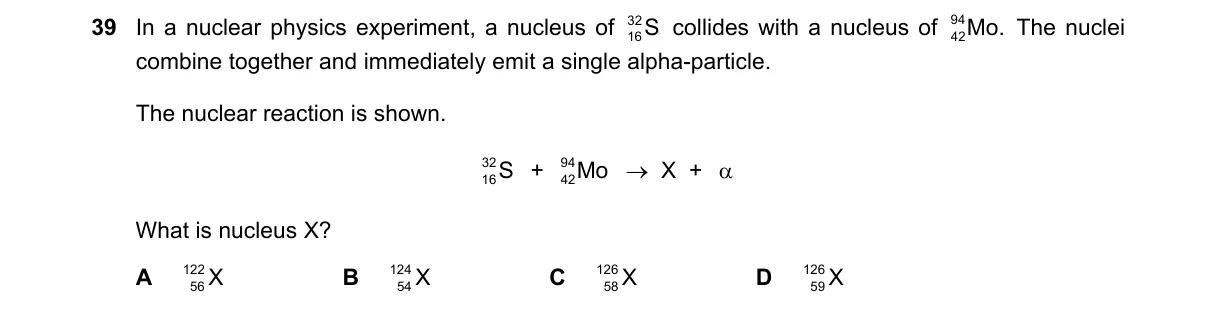
Answer choices
- A^{64}X
- B^{54}X
- C^{18}X
- D^{95}X
Explanation
Conservation of protons and neutrons in nuclear reactions Steps:
- Calculate total protons (Z): 16 (from S) + 42 (from Mo) = 58; alpha has 2 protons, so X has 58 - 2 = 56 protons.
- Calculate total neutrons: 32 - 16 = 16 (S) + 92 - 42 = 50 (Mo) = 66; alpha has 2 neutrons, so X has 66 - 2 = 64 neutrons.
- Mass number of X: 56 protons + 64 neutrons = 120, so X is ^{120}_{56} (barium nucleus).
- The choice identifies the neutron number of X as 64.
Why A is correct:
- A gives 64, matching the neutrons in X via conservation of neutron number (total neutrons minus those in alpha particle).
Why the others are wrong:
- B (54): Underestimates neutrons by not accounting for all from Mo (50) plus S (16) minus 2.
- C (18): Matches only S neutrons plus alpha protons, ignoring Mo and conservation.
- D (95): Approximates Mo mass but ignores S addition and alpha emission.
Final answer: A
Topic: Atoms, nuclei and radiation
Practice more A Levels Physics (9702) questions on mMCQ.me