A Levels Physics (9702)•9702/11/O/N/20
A Levels Physics (9702) — 9702/11/O/N/20, Question 38
Which statement about two isotopes of the same element is correct?
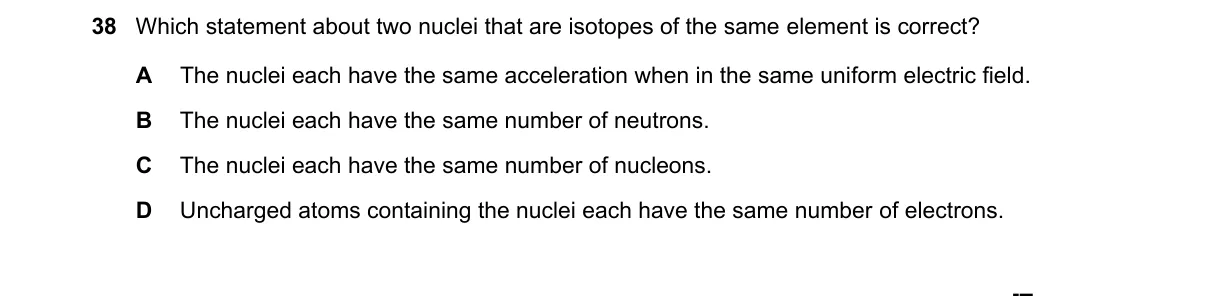
Answer choices
- AThe nuclei each have the same number of neutrons.
- BThe nuclei each have the same number of nucleons.
- CThe nuclei each have the same number of electrons.
- DUncharged atoms containing the nuclei each have the same number of electrons.
Explanation
Isotopes share atomic number but differ in neutron count
Steps:
- Isotopes of an element have the same atomic number (Z), meaning identical protons in the nucleus.
- They differ in mass number (A), due to varying neutrons, so total nucleons (protons + neutrons) differ.
- In uncharged atoms, electrons equal protons to maintain neutrality.
- Thus, neutral atoms of isotopes have identical electron counts, as Z is the same.
Why D is correct:
- By definition, isotopes have the same atomic number Z, so uncharged atoms have Z electrons each.
Why the others are wrong:
- A: Isotopes have different neutron numbers, as that's what distinguishes them.
- B: Nuclei have different total nucleons, since mass numbers (A) vary.
- C: Nuclei contain only protons and neutrons, never electrons.
Final answer: D
Topic: Atoms, nuclei and radiation
Practice more A Levels Physics (9702) questions on mMCQ.me