A Levels Physics (9702)•9702/11/O/N/20
A Levels Physics (9702) — 9702/11/O/N/20, Question 34
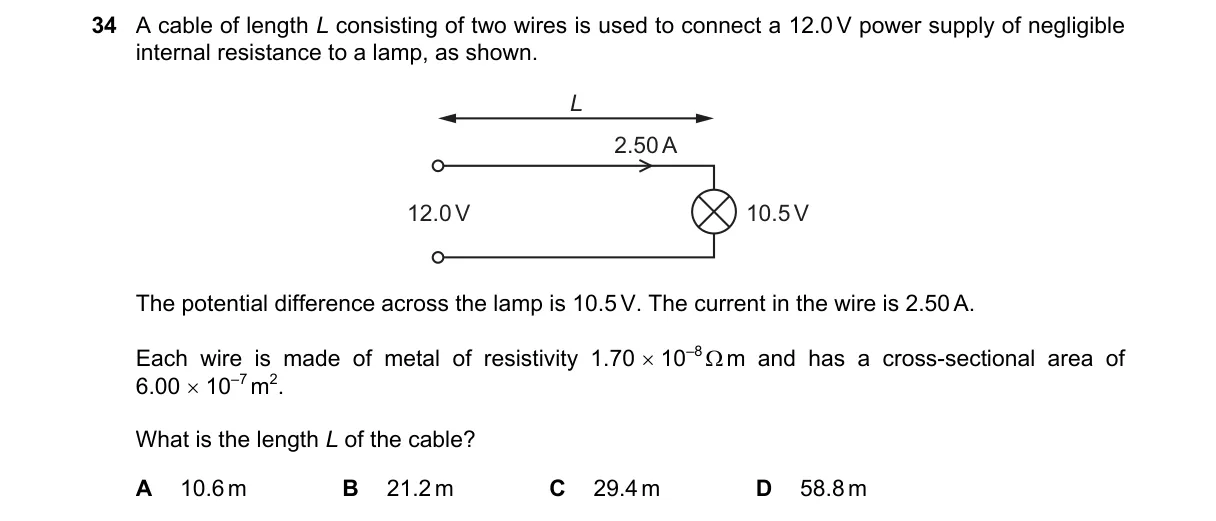
A cable of length L consisting of two wires is used to connect a 12V power supply of negligible internal resistance to a lamp, as shown. The potential difference across the lamp is 10V. The current in the wire is 2.5A. Each wire is made of metal of resistivity 1.70 × 10^-8 Ωm and has a cross-sectional area of 6.00 × 10^-6 m². What is the length L of the cable?
Answer choices
- A10.6m
- B21.2m
- C29.4m
- D58.8m
Explanation
Voltage drop across cable resistance Steps:
- Voltage drop in cable = 12 V - 10 V = 2 V.
- Total cable resistance R = drop / current = 2 V / 2.5 A = 0.8 Ω.
- Cable has two wires in series, so R = 2 × (ρ L / A), where ρ = 1.70 × 10^{-8} Ω m, A = 6.00 × 10^{-6} m².
- Solve for L: L = (R × A) / (2 ρ) = (0.8 × 6.00 × 10^{-6}) / (2 × 1.70 × 10^{-8}) = 10.6 m.
Why A is correct:
- Matches the calculated cable length using Ohm's law for the total resistance of two wires carrying current.
Why the others are wrong:
- B ignores one wire's resistance, doubling the length.
- C uses lamp voltage instead of drop, overestimating L.
- D assumes single wire or total circuit resistance, quadrupling L.
Final answer: A
Topic: Resistance and resistivity
Practice more A Levels Physics (9702) questions on mMCQ.me