A Levels Physics (9702)•9702/11/O/N/20
A Levels Physics (9702) — 9702/11/O/N/20, Question 19
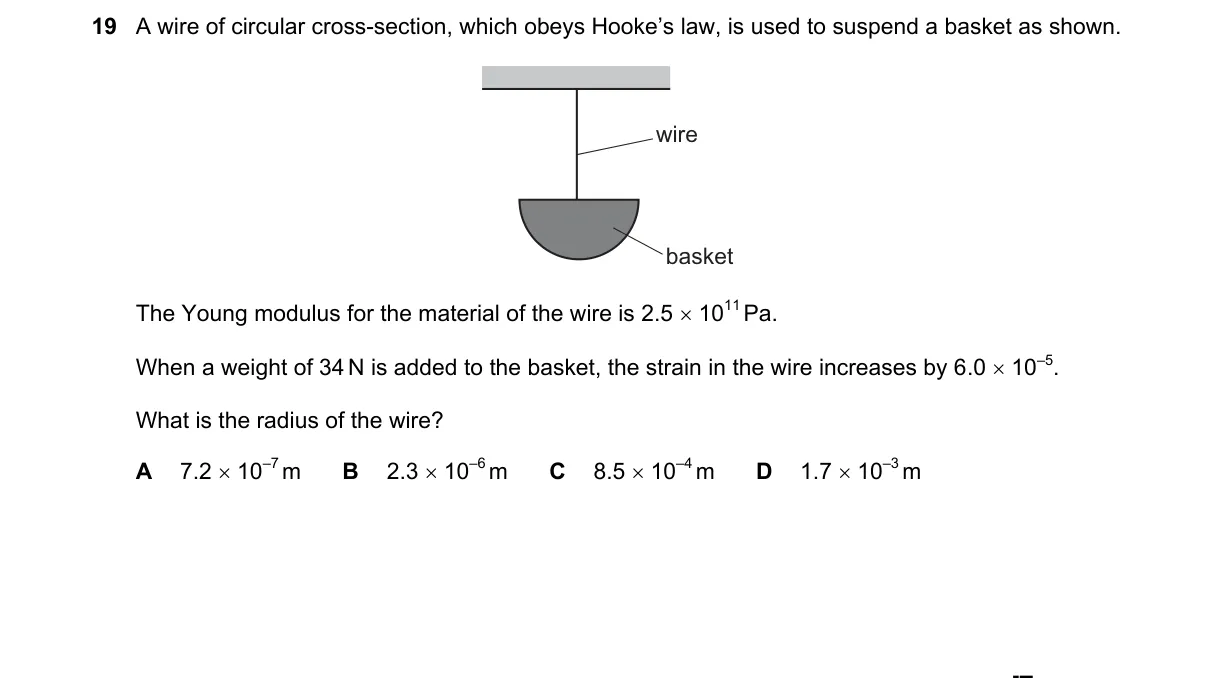
A wire of circular cross-section, which obeys Hooke's law, is used to suspend a basket as shown. The Young's modulus for the material of the wire is 2.5 × 10^11 Pa. When a weight of 34 N is added to the basket, the strain in the wire increases by 6.0 × 10^{-5}. What is the radius of the wire?
Answer choices
- A7.2 × 10^{-6} m
- B2.3 × 10^{-6} m
- C8.5 × 10^{-6} m
- D1.7 × 10^{-6} m
Explanation
Young's modulus relates stress and strain for the wire
Steps:
- Calculate stress σ = Y × Δε = (2.5 × 10^{11}) × (6.0 × 10^{-5}) = 1.5 × 10^7 Pa.
- Cross-sectional area A = F / σ = 34 / (1.5 × 10^7) = 2.3 × 10^{-6} m² (approx).
- For circular cross-section, A = π r^2, so r^2 = A / π ≈ 2.3 × 10^{-6} / 3.14 ≈ 7.3 × 10^{-7}.
- Thus r = √(7.3 × 10^{-7}) ≈ 8.5 × 10^{-6} m.
Why C is correct:
- It matches the radius from Y = (F / (π r^2)) / Δε, the definition of Young's modulus for uniaxial tension.
Why the others are wrong:
- A: From miscalculating A / π without square root.
- B: From taking r ≈ √(F / (Y Δε)) directly, ignoring π.
- D: From using diameter instead of radius in the area formula.
Final answer: C
Topic: Stress and strain
Practice more A Levels Physics (9702) questions on mMCQ.me