A Levels Physics (9702)•9702/11/O/N/20
A Levels Physics (9702) — 9702/11/O/N/20, Question 10
The diagram shows the masses and velocities of two trolleys that are about to collide. After the impact they move off together. What is the kinetic energy lost in the collision?
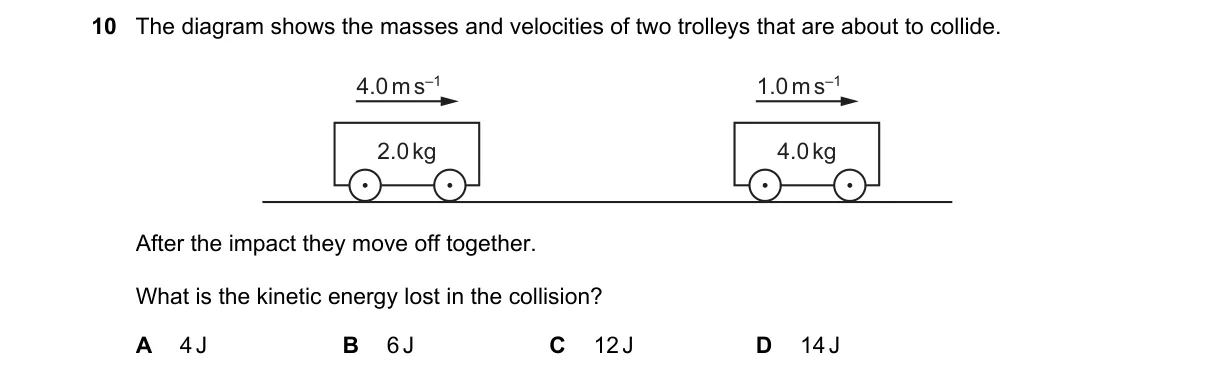
Answer choices
- A4J
- B6J
- C12J
- D14J
Explanation
Kinetic energy loss in perfectly inelastic collision
Steps:
- Calculate initial KE for each trolley: trolley 1 (4 kg, 1 m/s) is ½×4×1² = 2 J; trolley 2 (2 kg, 2 m/s opposite) is ½×2×2² = 4 J; total initial KE = 6 J.
- Apply conservation of momentum: initial momentum = 4×1 + 2×(-2) = 0 kg m/s; total mass = 6 kg, so final velocity = 0 m/s.
- Calculate final KE: ½×6×0² = 0 J.
- KE lost = initial KE - final KE = 6 J - 0 J = 6 J.
Why B is correct:
- In a perfectly inelastic collision, objects stick together, so final KE uses common velocity from momentum conservation, yielding 6 J loss via ½mv² formula.
Why the others are wrong:
- A: Ignores contribution from second trolley's KE.
- C: Equals total initial KE, forgetting to subtract final KE.
- D: Overestimates by adding extraneous energy or misapplying velocities.
Final answer: B
Topic: Linear momentum and its conservation
Practice more A Levels Physics (9702) questions on mMCQ.me