A Levels Physics (9702)•9702/13/O/N/19
A Levels Physics (9702) — 9702/13/O/N/19, Question 36
A cell of internal resistance 0.5Ω is connected to a fixed resistor of resistance 10Ω. The resistance of the resistor is changed to 20Ω. Which statement is not correct?
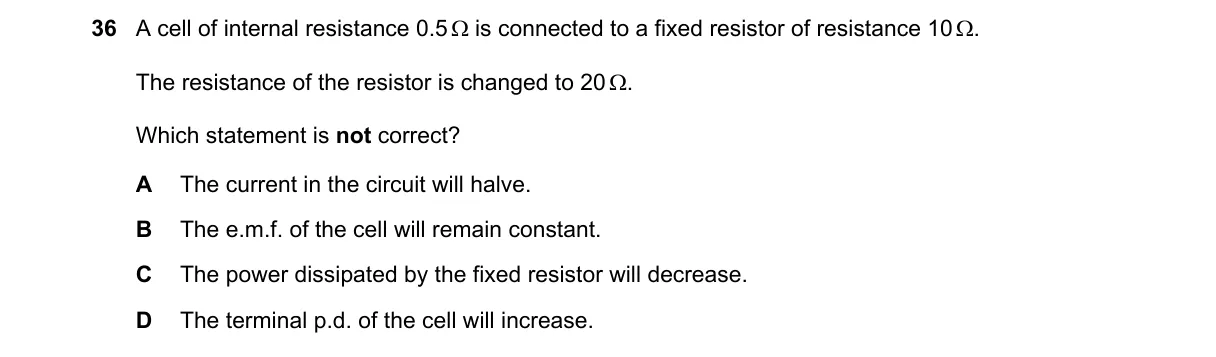
Answer choices
- AThe e.m.f. of the cell will halve.
- BThe current in the circuit will halve.
- CThe power dissipated by fixed resistor will decrease.
- DThe terminal p.d. of the cell will increase.
Explanation
Ohm's Law and Circuit Parameters with Changing Load
Steps:
- Denote cell e.m.f. as constant E; initial total resistance = 10.5Ω, current I₁ = E/10.5.
- New total resistance = 20.5Ω, current I₂ = E/20.5 ≈ I₁/2.
- Terminal p.d. V = I × external R; initial V₁ = I₁ × 10, new V₂ = I₂ × 20 > V₁.
- Power in resistor P = I² × R; initial P₁ = I₁² × 10, new P₂ = I₂² × 20 < P₁.
Why A is correct:
- e.m.f. E is an intrinsic property of the cell and remains unchanged regardless of external resistance.
Why the others are wrong:
- B: Current halves because total resistance roughly doubles (10.5Ω to 20.5Ω), so I ∝ 1/R.
- C: Power decreases as P ∝ I²R and I halves while R doubles, resulting in net reduction.
- D: Terminal p.d. increases toward E as external R rises, minimizing internal voltage drop (V = E × R/(R + r)).
Final answer: A
Topic: Practical circuits
Practice more A Levels Physics (9702) questions on mMCQ.me