A Levels Physics (9702)•9702/13/O/N/19
A Levels Physics (9702) — 9702/13/O/N/19, Question 35
A box containing two electrical components is connected into circuit. The variable resistor is adjusted and measurements are taken to determine the V-I characteristic for the box, as shown. Which arrangement of two electrical components in the box would create the best fit to the measured V-I characteristic?
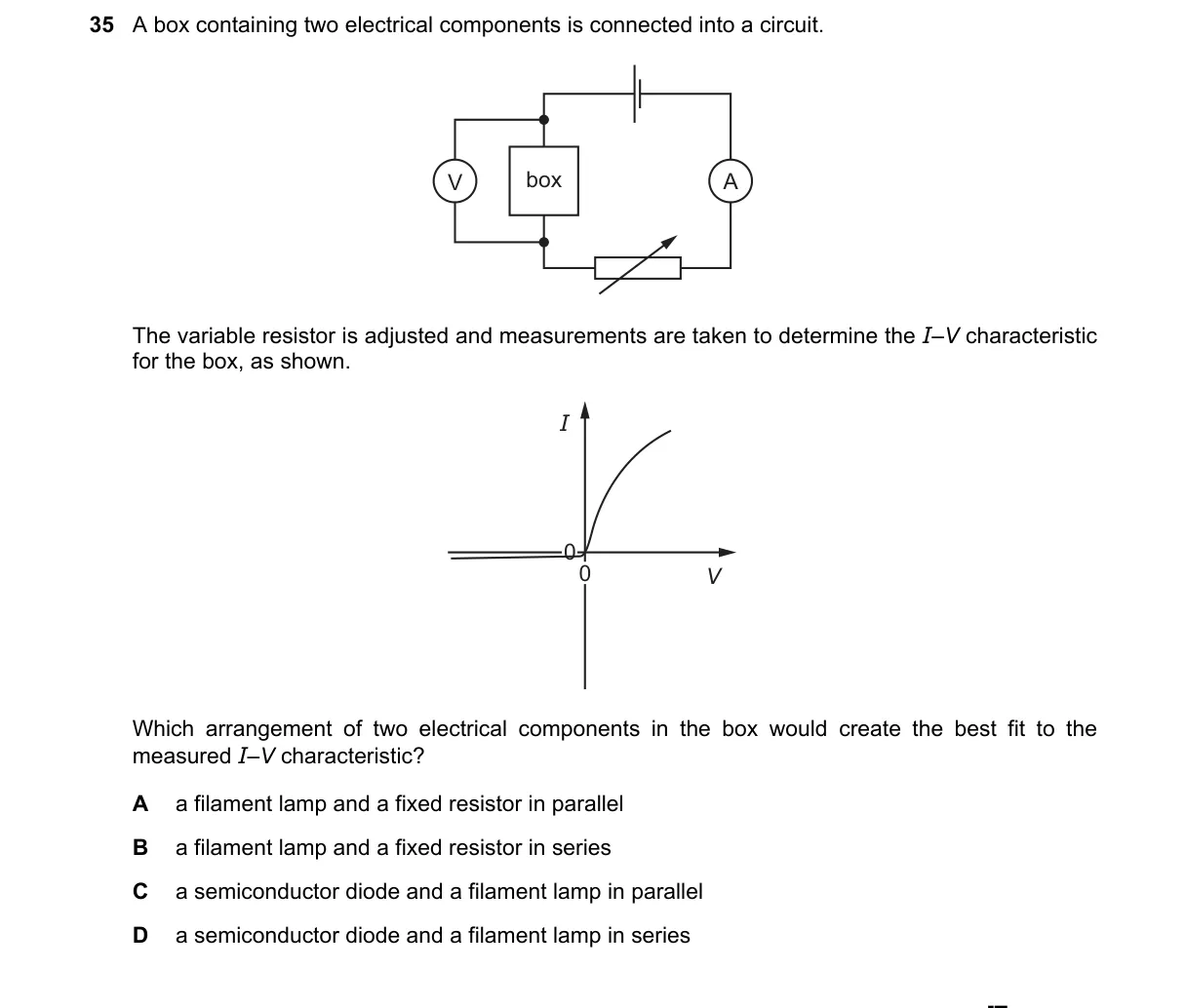
Answer choices
- Aa filament lamp and a fixed resistor in series
- Ba filament lamp and a fixed resistor in parallel
- Ca semiconductor diode and a filament lamp in series
- Da semiconductor diode and a filament lamp in parallel
Explanation
Non-linear V-I curve from diode and lamp in parallel
Steps:
- Identify key features: the V-I graph likely shows low current at negative V (reverse bias), sharp increase at forward bias, and gradual upward curve due to heating.
- Recall diode behavior: negligible current in reverse, exponential rise in forward per Shockley equation.
- Recall lamp behavior: initial ohmic, then resistance increases with temperature, causing non-linear V-I.
- Combine in parallel: diode dominates forward conduction at low V, lamp adds increasing resistance at higher V for curved fit.
Why D is correct:
- In parallel, the diode provides rectification (high reverse resistance, low forward), while the lamp's positive temperature coefficient creates the observed non-linear forward curve, matching I-V data per parallel circuit rules (V shared, I summed).
Why the others are wrong:
- A: Series lamp-resistor yields linear V-I with slight non-linearity from lamp, no rectification.
- B: Parallel lamp-resistor gives overall linear V-I, as both are mostly ohmic.
- C: Series diode-lamp blocks reverse current but forward V-I is linear (resistor-like) without parallel branching.
Final answer: D
Topic: Practical circuits
Practice more A Levels Physics (9702) questions on mMCQ.me