A Levels Physics (9702)•9702/13/O/N/19
A Levels Physics (9702) — 9702/13/O/N/19, Question 32
A uniform electric field is represented by five horizontal field lines. P and Q are two points in the field. The field causes a positively charged particle in vacuum to move from P to Q. Which statement about the particle must be correct?
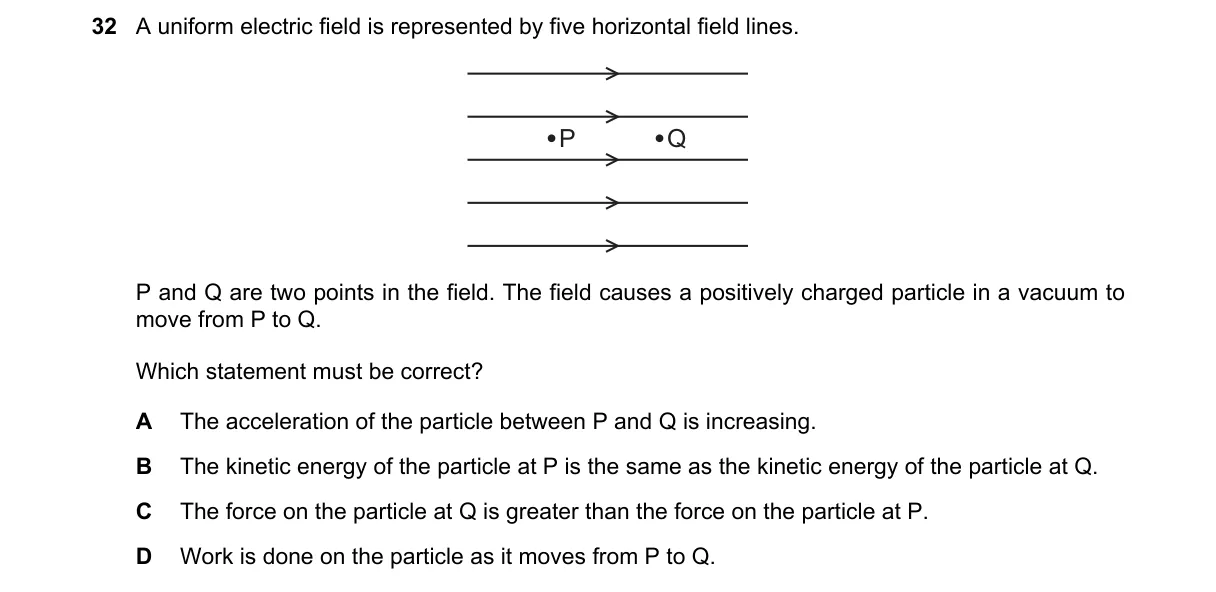
Answer choices
- AThe acceleration of the particle between P and Q is increasing.
- BThe force on the particle at Q is greater than the force on the particle at P.
- CThe kinetic energy of the particle at Q is greater than the kinetic energy at P.
- DWork is done on the particle as it moves from P to Q.
Explanation
Electric field performs work on accelerating charges
Steps:
- Uniform field implies constant electric force on the charge, as E is constant.
- Positive charge moves from P to Q in the field's direction, so displacement aligns with force.
- Work by field equals force times displacement (W = qEd, where d is distance along field).
- This work increases particle's kinetic energy, but work occurs regardless of initial speed.
Why D is correct:
- By work-energy theorem, non-zero force along path means positive work done on particle (W = ∫F·dl > 0).
Why the others are wrong:
- A: Uniform field gives constant force, so constant acceleration, not increasing.
- B: Constant field strength means equal force at P and Q.
- C: Kinetic energy increase depends on initial conditions; if starting with high speed at P, it could decrease if opposing initial motion, but work is always done.
Final answer: D
Topic: Uniform electric fields
Practice more A Levels Physics (9702) questions on mMCQ.me