A Levels Physics (9702)•9702/13/O/N/19
A Levels Physics (9702) — 9702/13/O/N/19, Question 24
A siren emits sound of frequency 1000 Hz. The siren moves at 20 m/s towards an observer who is standing still. The speed of sound in air is 330 m/s. Which expression would correctly give the frequency heard by the observer?
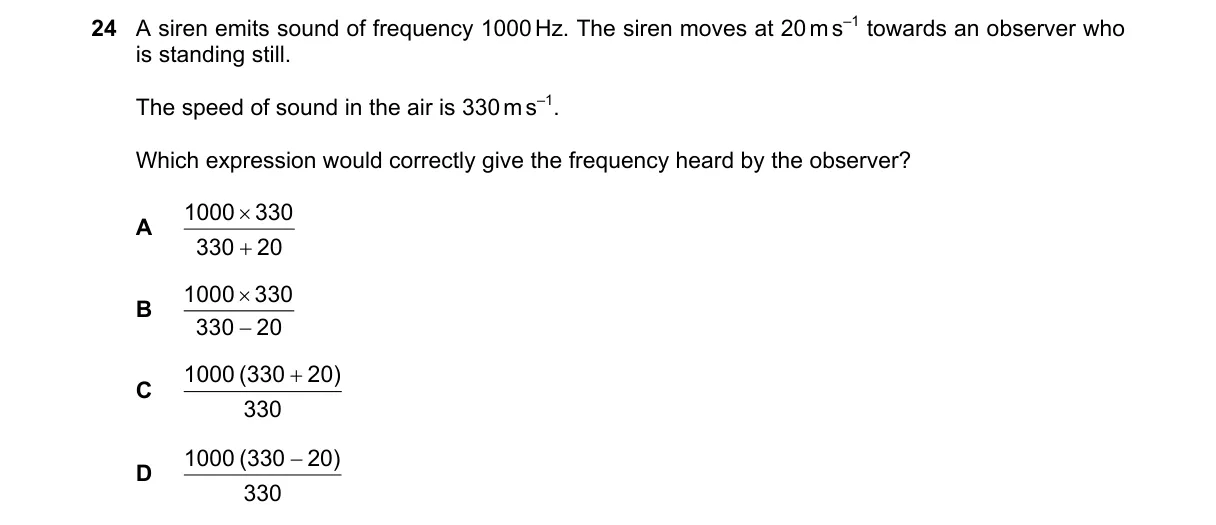
Answer choices
- A1000 × (330 + 20)/330
- B1000 × (330 - 20)/330
- C1000 × 330/(330 + 20)
- D1000 × 330/(330 - 20)
Explanation
Doppler Effect: Source Approaching Stationary Observer
Steps:
- Identify roles: Siren is moving source (vs = 20 m/s towards observer); observer stationary (vo = 0).
- Apply formula: Heard frequency f' = f × (v / (v - vs)), where v = speed of sound, f = source frequency.
- Substitute values: f' = 1000 × (330 / (330 - 20)).
- Result: Expression matches option D, yielding higher frequency due to wave compression.
Why D is correct:
- Matches Doppler formula f' = f × v / (v - vs) for source approaching stationary observer, increasing frequency as waves bunch up.
Why the others are wrong:
- A: Applies to stationary source with observer approaching (f × (v + vo)/v).
- B: Gives decreased frequency, suits observer receding from source (f × (v - vo)/v).
- C: For source receding from stationary observer (f × v / (v + vs)).
Final answer: D
Topic: Doppler effect for sound waves
Practice more A Levels Physics (9702) questions on mMCQ.me