A Levels Physics (9702)•9702/12/O/N/19
A Levels Physics (9702) — 9702/12/O/N/19, Question 33
There is current in a resistor of unknown resistance. Which two quantities can be used to calculate the energy dissipated by the resistor?
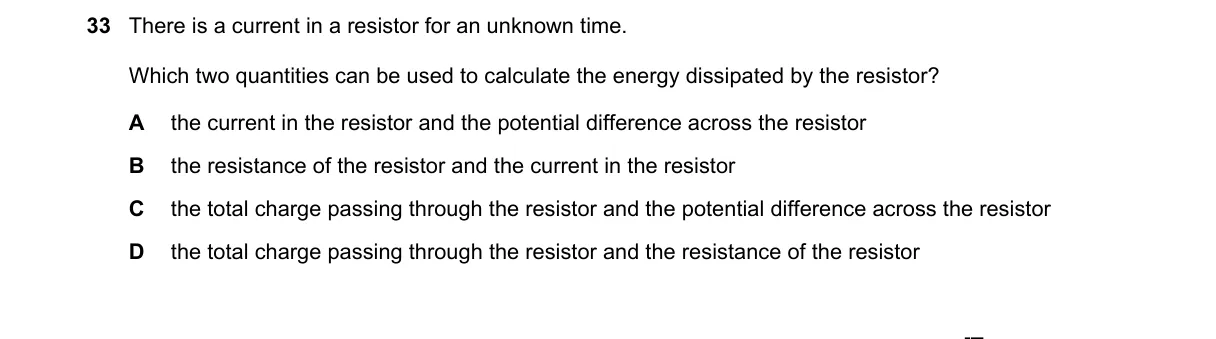
Answer choices
- Athe resistance of the resistor and the current in the resistor
- Bthe total charge passing through the resistor and the potential difference across the resistor
- Cthe total charge passing through the resistor and the resistance of the resistor
- Dthe total current passing through the resistor and the resistance of the resistor
Explanation
Energy dissipated equals charge times potential difference
Steps:
- Recall that energy dissipated by a resistor is the work done on charges, given by E = V × Q.
- Identify quantities in choices that match this formula directly.
- Eliminate options needing additional variables like time t.
- Confirm B provides V and Q without extras.
Why B is correct:
- E = V Q from the definition of electrical work, where potential difference V drives total charge Q through the resistor.
Why the others are wrong:
- A: R and I give power P = I²R, but energy requires multiplying by time t.
- C: Q and R yield E = (Q² R)/t via I = Q/t and V = IR, but time t is needed.
- D: "Total current" likely means I, and with R gives P = I²R, but energy needs t.
Final answer: B
Topic: Potential difference and power
Practice more A Levels Physics (9702) questions on mMCQ.me