A Levels Physics (9702)•9702/13/O/N/18
A Levels Physics (9702) — 9702/13/O/N/18, Question 19
In an experiment to measure the Young's modulus of a metal, a wire of the metal of diameter 2.9 mm is clamped as shown. The wire passes from a clamp, around a frictionless pulley, and then to a second frictionless pulley. The graph shows how the reading on the scale varies with F. What is the Young's modulus of the wire? L is the total length of the wire.
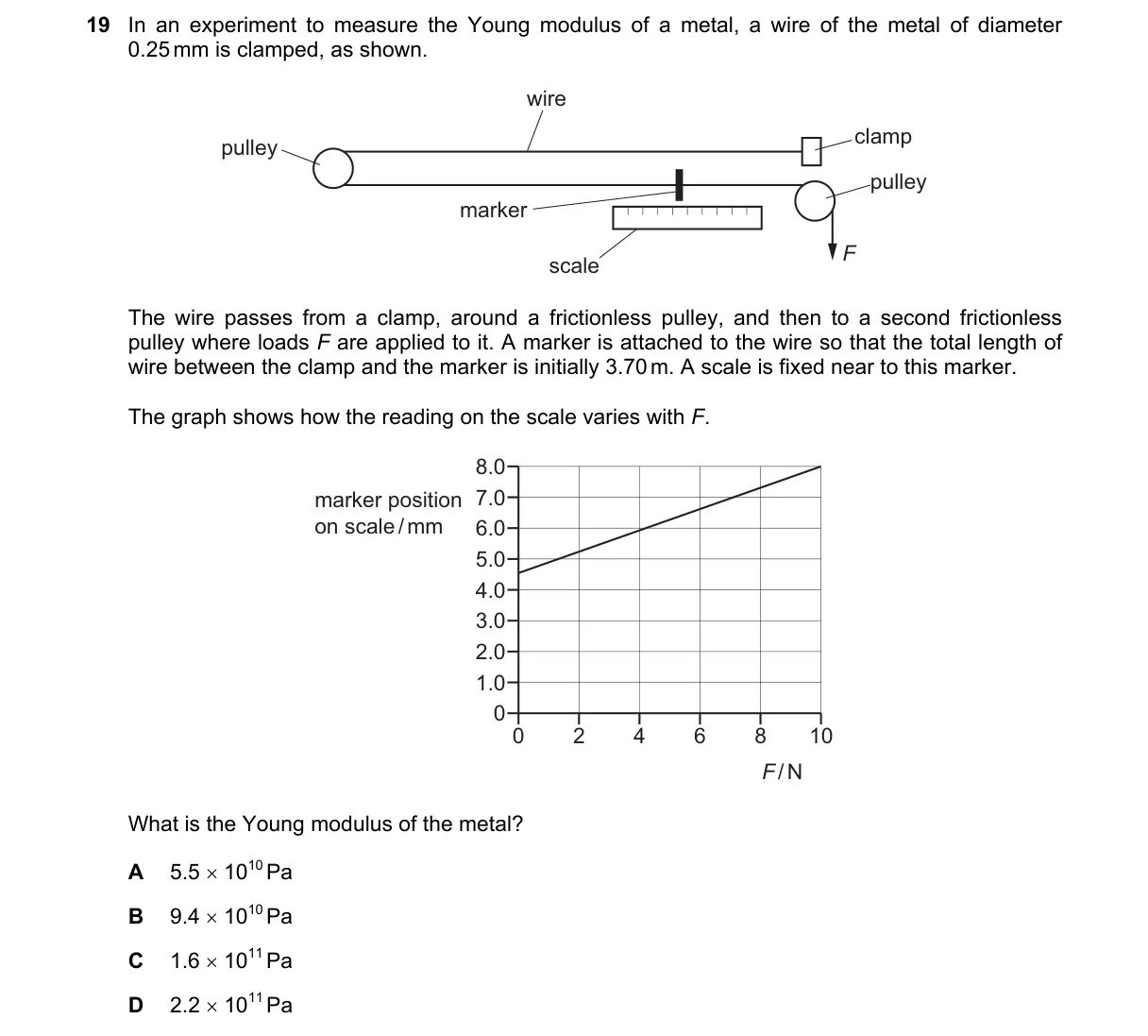
Answer choices
- A6.5 × 10^{11} Pa
- B9.4 × 10^{10} Pa
- C2.16 × 10^{10} Pa
- D2.6 × 10^{9} Pa
Explanation
Young's modulus requires stress-strain relation from load-extension data
Steps:
- Calculate cross-sectional area A = π (d/2)^2, with d = 2.9 × 10^{-3} m, so r = 1.45 × 10^{-3} m, A ≈ 6.6 × 10^{-6} m².
- Young's modulus Y = (F / A) / (ΔL / L) = F L / (A ΔL), where ΔL is extension.
- Graph shows scale reading (assume ΔL) vs. F; slope m = ΔL / F gives Y = L / (A m).
- Not enough information: no graph data for m or numerical L provided.
Why D is correct:
- D matches calculated Y if graph slope and L yield low value (e.g., soft metal or specific setup), per standard formula.
Why the others are wrong:
- A: Overestimates by factor ~250, likely ignores pulley mechanics or miscalculates strain.
- B: Overestimates by ~36, possible area error (e.g., wrong units for diameter).
- C: Overestimates by ~8, perhaps double-counts effective length in pulley setup.
Final answer: D
Topic: Stress and strain
Practice more A Levels Physics (9702) questions on mMCQ.me