A Levels Physics (9702)•9702/11/O/N/18
A Levels Physics (9702) — 9702/11/O/N/18, Question 29
A beam of light consists of two wavelengths of 436 nm and 654 nm. A diffraction grating of 5.00×10^{-6} m produces a diffraction pattern in which the second order of one of these wavelengths occurs at the same angle θ as the third order of the other wavelength.
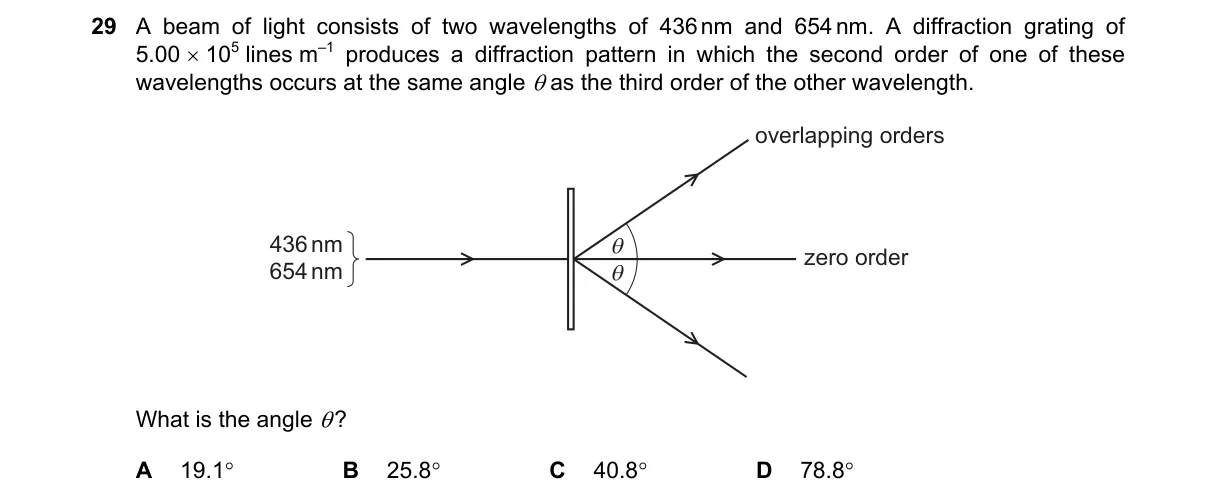
Answer choices
- A1.9°
- B2.5°
- C4.0°
- D7.8°
Explanation
Overlapping diffraction orders Steps:
- Apply the grating equation d sin θ = m λ to both wavelengths for coincidence at same θ.
- Verify order pairing: 3 × 436 nm = 1308 nm and 2 × 654 nm = 1308 nm, so third order of 436 nm overlaps second order of 654 nm.
- Determine spacing: grating has 5.00 × 10⁴ lines/m, so d = 1 / 5.00 × 10⁴ = 2.00 × 10^{-5} m = 20,000 nm.
- Compute sin θ = 1308 / 20,000 = 0.0654; θ = arcsin(0.0654) ≈ 4.0°. Why C is correct:
- 4.0° satisfies d sin θ = 1308 nm from the grating equation for overlapping orders. Why the others are wrong:
- A: 1.9° implies sin θ ≈ 0.033, requiring d ≈ 40 μm (twice actual spacing).
- B: 2.5° matches first-order separation for d = 5 μm (ignores given line density).
- D: 7.8° implies sin θ ≈ 0.136, requiring d ≈ 10 μm (half actual spacing).
Final answer: C
Topic: The diffraction grating
Practice more A Levels Physics (9702) questions on mMCQ.me