A Levels Physics (9702)•9702/14/M/J/25
A Levels Physics (9702) — 9702/14/M/J/25, Question 13
A cylindrical iceberg of height H floats in sea water. The top of the iceberg is at height h above the surface of the water. The density of ice is ρ_i, and the density of sea water is ρ_w. What is the height h of the iceberg above the sea water?
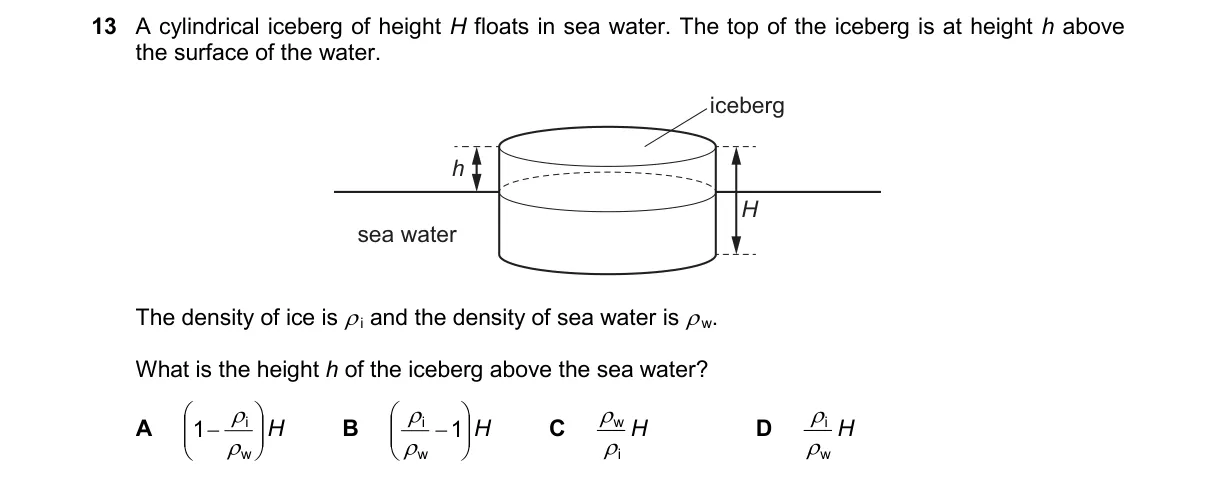
Answer choices
- A\left(1 - \frac{\rho_i}{\rho_w}\right) H
- B\frac{\rho_i}{\rho_w} H
- C\frac{H}{\rho_w}
- D\frac{\rho_w H}{\rho_i}
Explanation
Archimedes' Principle for Floating Iceberg
Steps:
- The iceberg floats when buoyant force equals its weight: ρ_w * V_sub * g = ρ_i * V_total * g.
- V_total = A * H, where A is cross-sectional area; V_sub = A * (H - h).
- Substitute: ρ_w * A * (H - h) = ρ_i * A * H.
- Simplify: H - h = (ρ_i / ρ_w) H, so h = H (1 - ρ_i / ρ_w).
Why A is correct:
- It directly follows from equating displaced water weight to iceberg weight via Archimedes' principle.
Why the others are wrong:
- B: Gives submerged height, not exposed height.
- C: Ignores densities, yielding incorrect units.
- D: Inverts densities, implying sinking behavior.
Final answer: A
Topic: Density and pressure
Practice more A Levels Physics (9702) questions on mMCQ.me