A Levels Physics (9702)•9702/14/M/J/25
A Levels Physics (9702) — 9702/14/M/J/25, Question 12
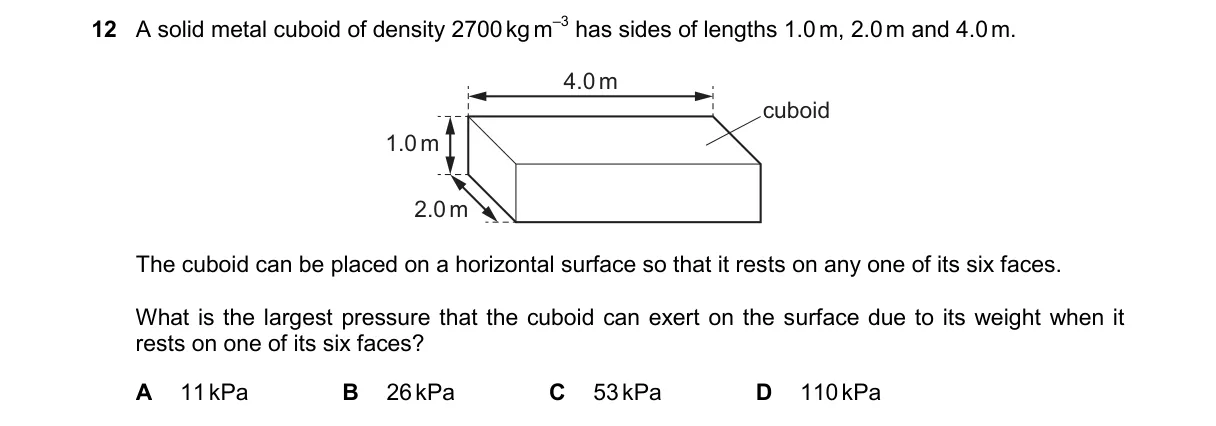
A solid metal cuboid of density 2700kg/m³ has sides of length 1.0m, 2.0m and 4.0m. The cuboid can be placed on a horizontal surface so that it rests on any one of its six faces. What is the largest pressure that the cuboid can exert on the surface due to its weight when it rests on one of its six faces?
Answer choices
- A11kPa
- B26kPa
- C53kPa
- D110kPa
Explanation
Maximum pressure on smallest face area
Steps:
- Volume = 1 m × 2 m × 4 m = 8 m³
- Mass = 2700 kg/m³ × 8 m³ = 21600 kg
- Weight = 21600 kg × 10 m/s² = 216000 N
- Smallest area = 1 m × 2 m = 2 m²; pressure = 216000 N / 2 m² = 108 kPa ≈ 110 kPa
Why D is correct:
- Pressure P = weight / area; maximum P when area is minimized per the formula.
Why the others are wrong:
- A: 11 kPa from incorrect weight or area calculation.
- B: 26 kPa from largest area (2 m × 4 m = 8 m²): 216000 N / 8 m² = 27 kPa.
- C: 53 kPa from medium area (1 m × 4 m = 4 m²): 216000 N / 4 m² = 54 kPa.
Final answer: D
Topic: Density and pressure
Practice more A Levels Physics (9702) questions on mMCQ.me