A Levels Physics (9702)•9702/13/M/J/25
A Levels Physics (9702) — 9702/13/M/J/25, Question 9
Which statement defines force?
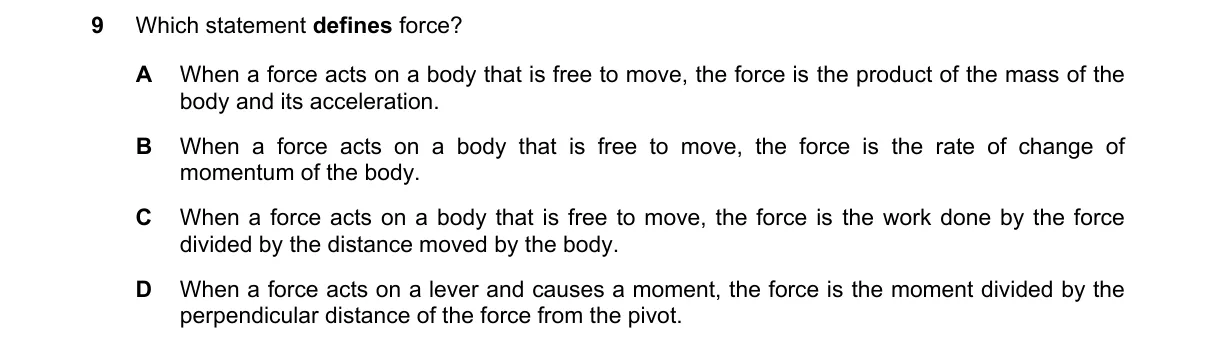
Answer choices
- AWhen a force acts on a body that is free to move, the force is the product of the mass of the body and its acceleration.
- BWhen a force acts on a body that is free to move, the force is the rate of change of momentum of the body.
- CWhen a force acts on a body that is free to move, the force is the work done by the force divided by the distance moved by the body.
- DWhen a force acts on a lever and causes a moment, the force is the moment divided by the perpendicular distance of the force from the pivot.
Explanation
Force as Rate of Change of Momentum
Steps:
- Recall Newton's second law: force equals the rate of change of momentum for a body free to move.
- Evaluate option A: it describes F = ma, valid only for constant mass.
- Evaluate option B: it matches the general definition F = dp/dt.
- Eliminate C and D: they relate to work and torque, not force directly.
Why B is correct:
- It aligns with Newton's second law in its most general form, F = Δp/Δt, where momentum p = mv.
Why the others are wrong:
- A: Limits to constant mass; ignores variable mass cases like rockets.
- C: Defines average force via work-energy theorem (W = Fd), not the fundamental definition.
- D: Describes torque (τ = Fd), not force itself.
Final answer: B
Topic: Momentum and Newton's laws of motion
Practice more A Levels Physics (9702) questions on mMCQ.me