A Levels Physics (9702)•9702/13/M/J/25
A Levels Physics (9702) — 9702/13/M/J/25, Question 8
Two spheres are released from rest at equal heights above the ground. Both spheres have equal volumes. One sphere has larger density than the other sphere. Both spheres reach terminal velocity. Which statement is correct while both spheres are at terminal velocity?
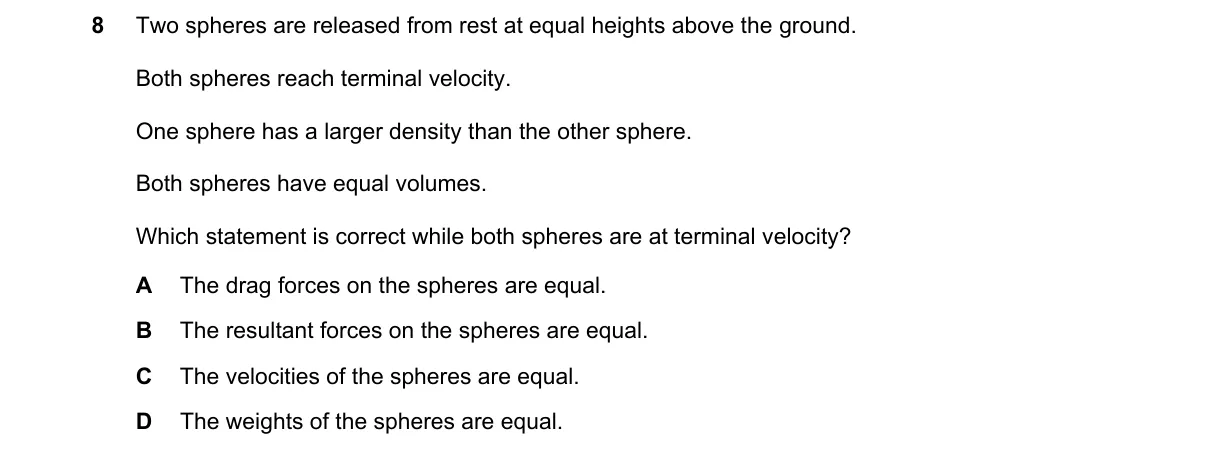
Answer choices
- AThe drag forces on the spheres are equal.
- BThe resultant forces on the spheres are equal.
- CThe velocities of the spheres are equal.
- DThe weights of the spheres are equal.
Explanation
Terminal velocity balances forces
Steps:
- Terminal velocity occurs when gravitational force (weight) equals drag force, making net (resultant) force zero.
- Both spheres reach terminal velocity, so each has zero net force.
- Resultant force is the vector sum of all forces; zero for both means they are equal.
- Denser sphere has greater weight, so greater drag force at terminal velocity, but net force remains zero.
Why B is correct:
- By Newton's first law, at terminal velocity, resultant force is zero for any object in steady motion, so equal for both spheres.
Why the others are wrong:
- A: Drag force equals weight for each; denser sphere has larger weight, so larger drag.
- C: Terminal velocity differs due to unequal masses from densities.
- D: Weight differs as volumes equal but densities unequal, so masses unequal.
Final answer: B
Topic: Equilibrium of forces
Practice more A Levels Physics (9702) questions on mMCQ.me