A Levels Physics (9702)•9702/12/M/J/25
A Levels Physics (9702) — 9702/12/M/J/25, Question 35
The diagram shows a cell of internal resistance 1Ω connected to a variable resistor. When the variable resistor has resistance 2Ω, the current in the cell is I, and the terminal potential difference across the cell is V. The variable resistor is adjusted to a new resistance of 4Ω. What is the new current in the cell and the new terminal p.d. across the cell?
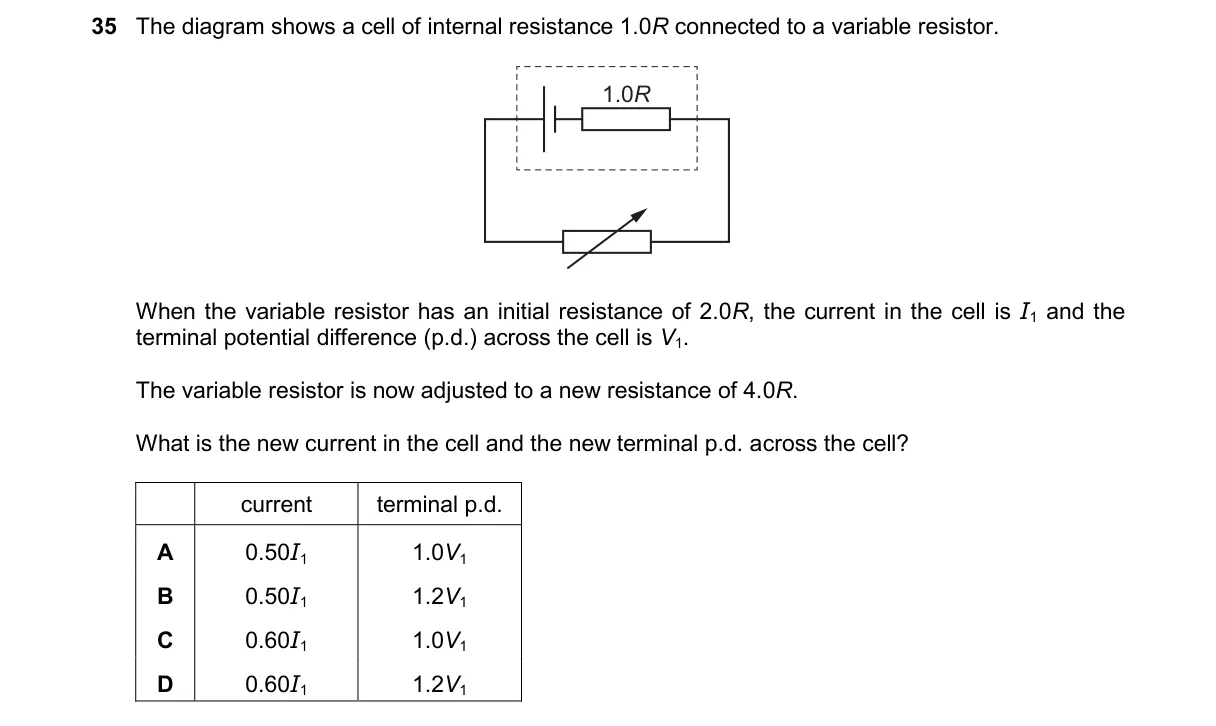
Answer choices
- A0.5I, 1.0V
- B0.6I, 1.2V
- C0.8I, 1.2V
- D0.80I, 1.2V
Explanation
Internal resistance and load affect current and terminal voltage
Steps:
- Initial: total resistance = 2 Ω + 1 Ω = 3 Ω; I = E/3; V = I × 2 Ω = 2I; E = V + I × 1 Ω = 3I.
- New: total resistance = 4 Ω + 1 Ω = 5 Ω; new current = E/5 = 3I/5 = 0.6I.
- New terminal p.d. = new current × 4 Ω = 0.6I × 4 = 2.4I.
- Initial V = 2I, so new p.d. = 2.4I = 1.2V.
Why B is correct:
- Ohm's law applied to total circuit resistance and terminal voltage formula V = E - Ir yield 0.6I and 1.2V exactly.
Why the others are wrong:
- A: Assumes current halves with doubled load (ignoring internal r), but terminal p.d. stays V, not 1.0V.
- C: 0.8I misapplies ratio as 4/5 (fraction of emf across load), not actual current.
- D: Same error as C, with extra decimal; current is 3/5 I = 0.6I, not 0.80I.
Final answer: B
Topic: Practical circuits
Practice more A Levels Physics (9702) questions on mMCQ.me