A Levels Physics (9702)•9702/12/M/J/25
A Levels Physics (9702) — 9702/12/M/J/25, Question 30
What is not a necessary condition for the waves to produce a stationary wave?
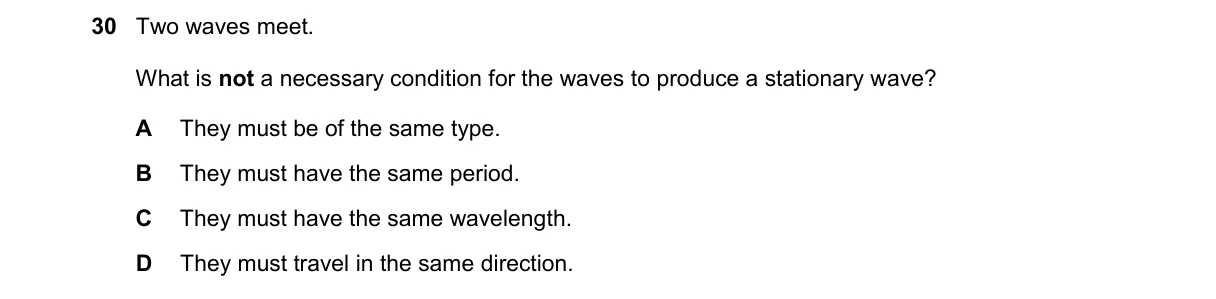
Answer choices
- AThey must be of the same type.
- BThey must have the same wavelength.
- CThey must have the same period.
- DThey must travel in the same direction.
Explanation
Stationary waves form via superposition of oppositely traveling coherent waves
Steps:
- Identify conditions for stationary waves: two waves must superpose with fixed interference pattern.
- Require same frequency (period) and wavelength for nodes/antinodes to remain stationary.
- Waves must be coherent and of same type for effective interference.
- Direction must be opposite; same direction yields progressive wave, not stationary.
Why D is correct:
- Stationary waves demand opposite directions for phase differences creating fixed nodes, per superposition principle.
Why the others are wrong:
- A: Different types (e.g., transverse vs. longitudinal) prevent proper interference.
- B: Unequal wavelengths cause moving beats, not fixed pattern.
- C: Different periods imply unequal frequencies, disrupting stationary nodes.
Final answer: D
Topic: Stationary waves
Practice more A Levels Physics (9702) questions on mMCQ.me