A Levels Physics (9702)•9702/11/M/J/25
A Levels Physics (9702) — 9702/11/M/J/25, Question 37
A cell is connected in series with an ammeter and a variable resistor. A voltmeter is used to measure the p.d. across the variable resistor. The resistance of the variable resistor is varied, and the p.d. across the variable resistor and the current are recorded. The graph shows the variation of current with p.d. across the variable resistor. What is the internal resistance of the cell?
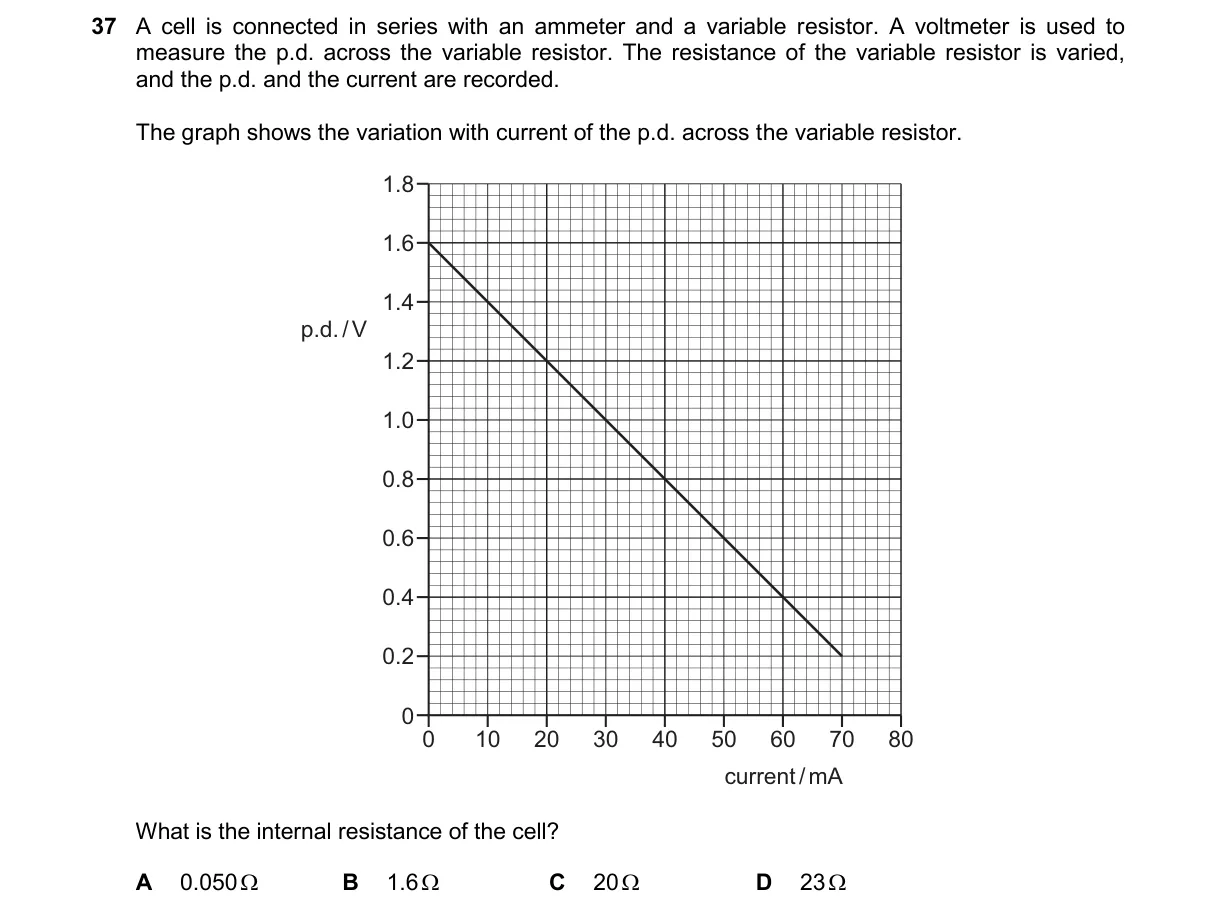
Answer choices
- A0.5Ω
- B1.6Ω
- C2Ω
- D23Ω
Explanation
Internal resistance from slope of I-V graph
Steps:
- The graph of current (I) versus potential difference (V) across the variable resistor is a straight line from (V=0, I=E/r) to (V=E, I=0), where E is emf and r is internal resistance.
- The slope of this line is ΔI/ΔV = -1/r.
- Calculate the slope from the graph (e.g., rise over run gives -0.5 A/V).
- Thus, r = -1/slope = -1/(-0.5) = 2 Ω.
Why C is correct:
- The slope of the I-V line is -1/r by Ohm's law for the cell (E = V + I r), confirming r = 2 Ω matches the graph's slope.
Why the others are wrong:
- A: 0.5 Ω would require slope = -2 A/V, steeper than shown.
- B: 1.6 Ω would require slope ≈ -0.625 A/V, not matching the graph.
- D: 23 Ω would require slope ≈ -0.043 A/V, nearly horizontal, unlike the graph.
Final answer: C
Topic: Practical circuits
Practice more A Levels Physics (9702) questions on mMCQ.me