A Levels Physics (9702)•9702/11/M/J/25
A Levels Physics (9702) — 9702/11/M/J/25, Question 25
Which statement about longitudinal and transverse wave motion for a progressive wave
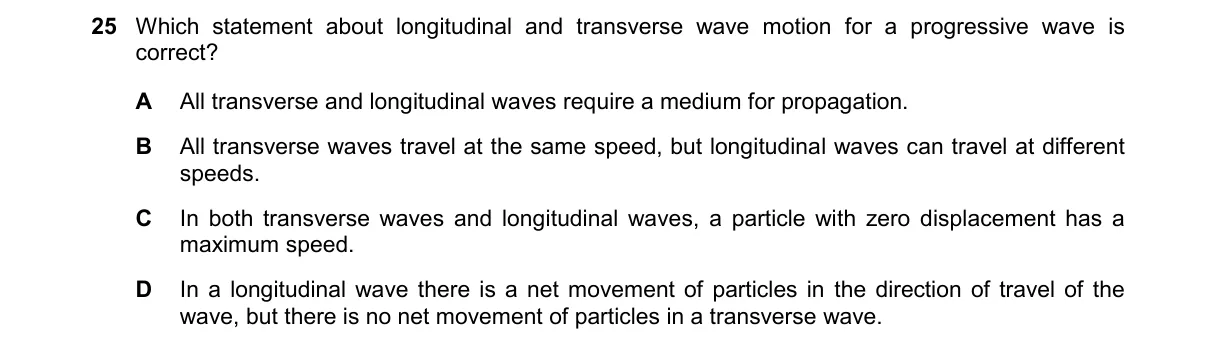
Answer choices
- AAll transverse and longitudinal waves require a medium for propagation.
- BBoth transverse waves travel at the same speed, but longitudinal waves can travel at different speeds.
- CIn transverse waves and longitudinal waves, a particle with zero displacement has maximum speed.
- DIn a longitudinal wave there is no movement of particles in the direction of travel of the wave, but there is movement of particles in transverse wave.
Explanation
Particle velocity in transverse and longitudinal waves
Steps:
- Recall that in progressive waves, particle displacement varies sinusoidally with time and position.
- For both transverse and longitudinal waves, particle velocity is the derivative of displacement, given by .
- Maximum velocity occurs when displacement is zero, as reaches 1 when the sine argument is , where displacement cosine is zero.
- This holds for both wave types since the velocity-displacement relation is identical.
Why C is correct:
- In simple harmonic motion underlying both waves, velocity , so at zero displacement , speed is maximum .
Why the others are wrong:
- A: Electromagnetic transverse waves propagate without a medium.
- B: Wave speed depends on medium properties, so transverse and longitudinal speeds differ (e.g., sound vs. light in air).
- D: Longitudinal waves involve particle oscillation parallel to propagation direction, unlike transverse.
Final answer: C
Topic: Transverse and longitudinal waves
Practice more A Levels Physics (9702) questions on mMCQ.me