A Levels Physics (9702)•9702/11/M/J/25
A Levels Physics (9702) — 9702/11/M/J/25, Question 18
The points X, Y and Z are on a rough, horizontal surface. A box P is pushed across the surface from X to Y and then to Z. The distance from X to Y is 3.0 m. The work done against the friction force in moving the box from Y to Z is 200 J. The work done against the friction force in moving the box from X to Y is 150 J. An identical box Q is pushed in a straight line from X to Z. The magnitude of the friction force between boxes P and the surface is constant. How much extra work is done against the friction force in P than Q?
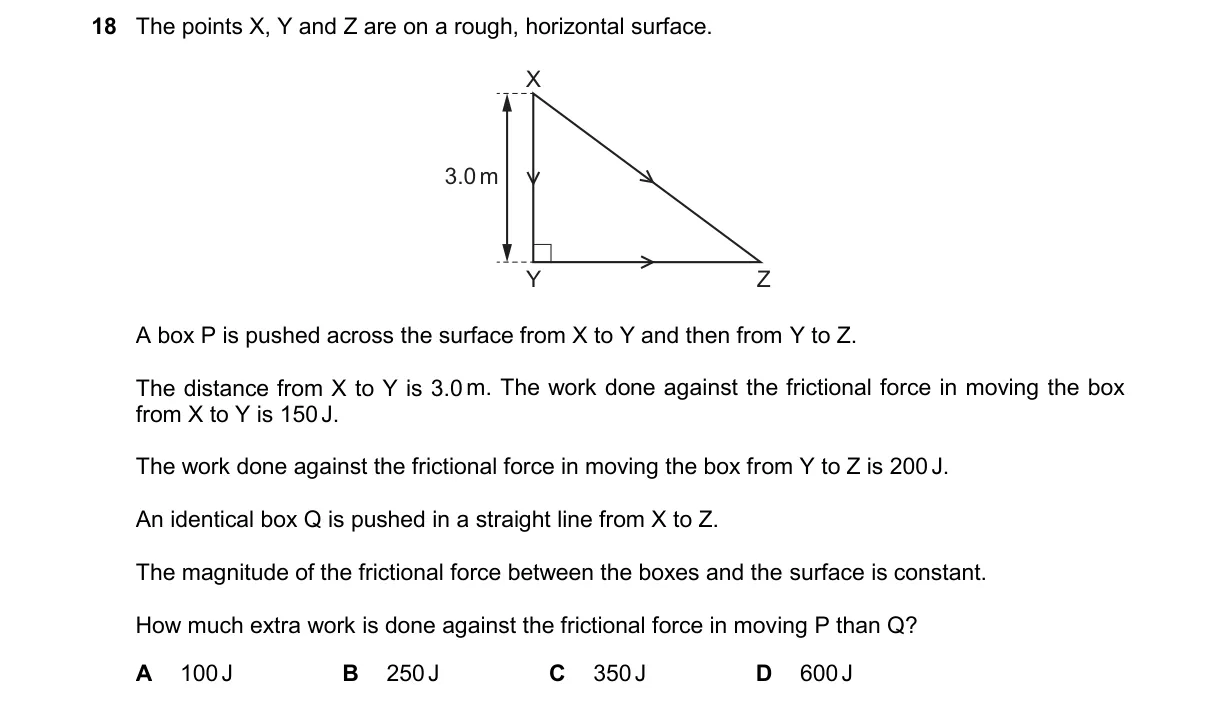
Answer choices
- A100 J
- B250 J
- C350 J
- D600 J
Explanation
Insufficient geometric information to calculate straight-line distance XZ Steps:
- Friction force f = work_{XY} / d_{XY} = 150 J / 3.0 m = 50 N (constant magnitude).
- Distance YZ = work_{YZ} / f = 200 J / 50 N = 4.0 m.
- Path length for P: 3.0 m + 4.0 m = 7.0 m; total work_P = 150 J + 200 J = 350 J.
- Path length for Q: straight-line distance d_{XZ} (unknown); work_Q = f × d_{XZ} = 50 × d_{XZ}.
- Extra work = work_P - work_Q = 50 × (7 - d_{XZ}); cannot compute without d_{XZ}.
Not enough information.
Final answer: Not enough information.
Topic: Energy conservation
Practice more A Levels Physics (9702) questions on mMCQ.me