A Levels Physics (9702)•9702/13/M/J/24
A Levels Physics (9702) — 9702/13/M/J/24, Question 7
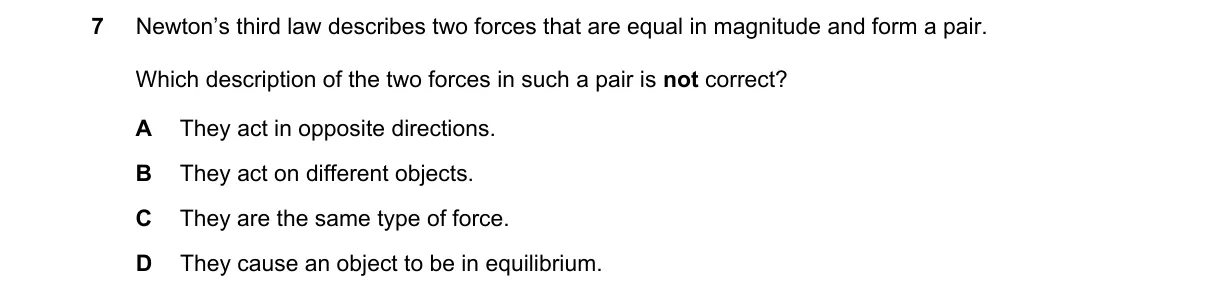
Newton's third law describes two forces that are equal in magnitude and form a pair. Which description of the two forces in such a pair is not correct?
Answer choices
- AThey act in opposite directions.
- BThey act on different objects.
- CThey are of the same type of force.
- DThey cause an object to be in equilibrium.
Explanation
Newton's Third Law Action-Reaction Force Pairs
Steps:
- Recall Newton's third law: Every action force has an equal and opposite reaction force forming an action-reaction pair.
- Verify pair properties: Forces are equal in magnitude, opposite in direction, act on different objects, and are of the same type (e.g., both gravitational).
- Check option D: Action-reaction forces act on separate objects, so they do not balance forces on a single object to cause equilibrium.
- Confirm D as the incorrect description by ensuring A, B, and C align with the law.
Why D is correct:
- Action-reaction forces act on different objects, so they cannot cancel for equilibrium of one object, per Newton's third law definition.
Why the others are wrong:
- A: Action-reaction forces act in opposite directions, as stated in the law.
- B: They act on different objects, a core feature of the pair.
- C: They are the same type (e.g., both contact or gravitational forces).
Final answer: D
Topic: Momentum and Newton's laws of motion
Practice more A Levels Physics (9702) questions on mMCQ.me