A Levels Physics (9702)•9702/13/M/J/24
A Levels Physics (9702) — 9702/13/M/J/24, Question 37
The diagram shows a potentiometer circuit used to compare electromotive forces (e.m.f.), E1 and E2, of two cells. A sliding contact is moved along the wire XY. When the sliding contact is at position P, the galvanometer reads zero. The circuit is changed so E1 reads zero when sliding contact is at a new position of P. Which change could have been made to the circuit?
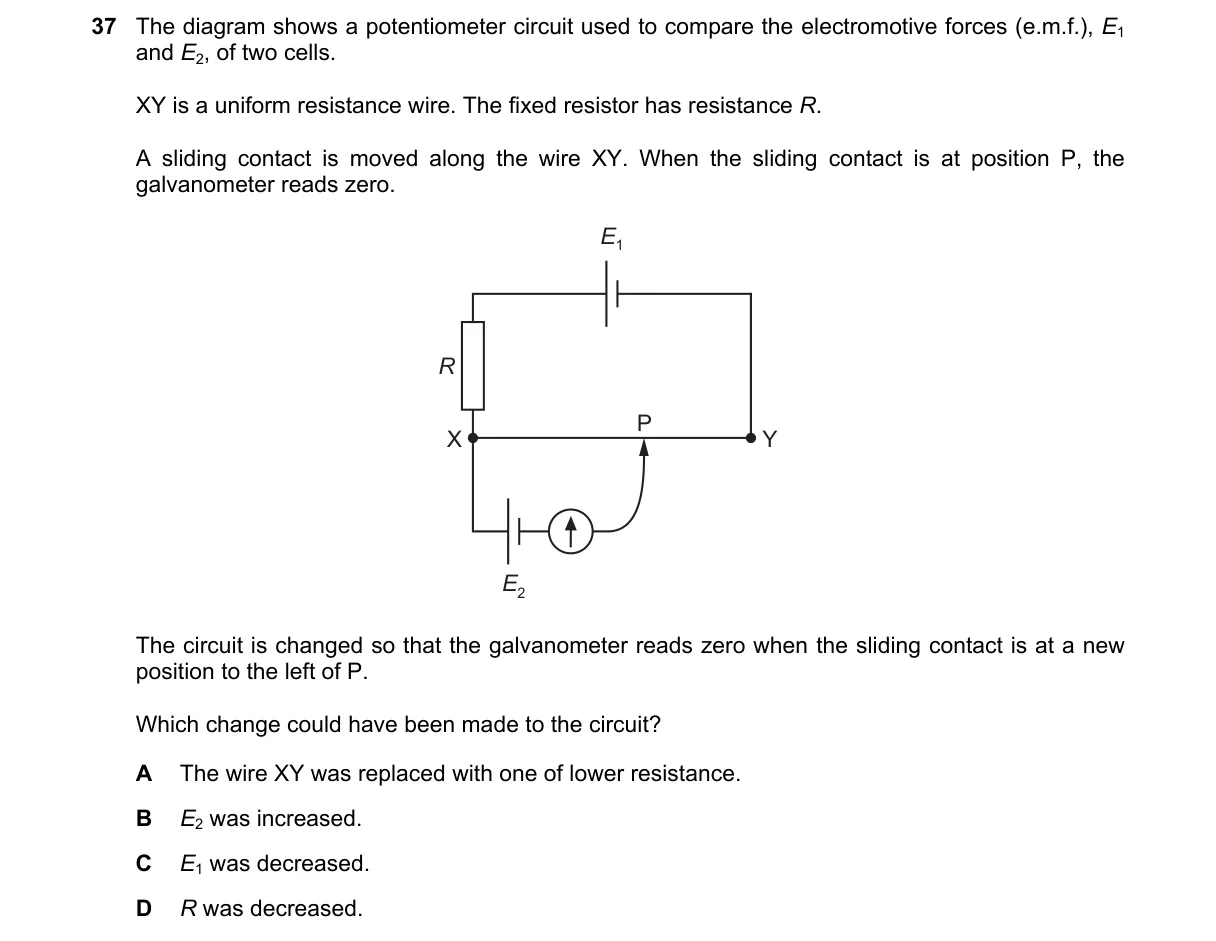
Answer choices
- AXY would have been made of lower resistance.
- BE1 was increased.
- CE2 was decreased.
- DR was decreased.
Explanation
Potentiometer null point shifts with changes to potential gradient
Steps:
- Balance condition: cell EMF ε equals potential drop to null point, ε = k l, where k is potential gradient, l is balance length.
- k proportional to current I through wire XY; I = driving EMF / (R + R_XY).
- Decreasing R increases I, raising k.
- Higher k for E1 reduces its balance length l' = E1 / k versus original, creating new null position P.
Why D is correct:
- Decreasing R boosts current I per Ohm's law, increasing k and shifting E1's null point to a shorter length, a new position.
Why the others are wrong:
- A. Lower XY resistance reduces k (less PD per length for same I), lengthening null point for E1.
- B. Increasing E1 raises ε, lengthening null point without circuit change.
- C. Decreasing E2 affects only its own balance, not E1's position.
Final answer: D
Topic: Potential dividers
Practice more A Levels Physics (9702) questions on mMCQ.me