A Levels Physics (9702)•9702/13/M/J/24
A Levels Physics (9702) — 9702/13/M/J/24, Question 24
An ambulance siren sounds with a single frequency f. The ambulance travels towards, passes close to, and then travels away from a stationary observer. Which statement describes the frequency of the sound detected by the observer as the ambulance travels towards, passes close to, and then travels away from the observer?
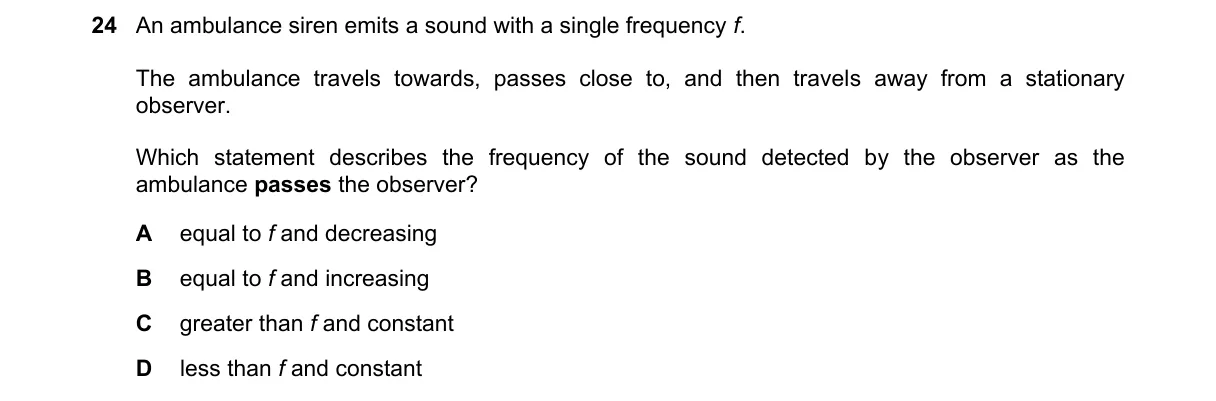
Answer choices
- Aequal to f and increasing
- Bequal to f and decreasing
- Cgreater than f and constant
- Dless than f and constant
Explanation
Doppler Effect for Sound
Steps:
- The Doppler effect changes observed frequency based on relative motion: higher when source approaches, lower when receding.
- As ambulance approaches, observer detects frequency > f due to compressed waves.
- At the instant of passing close by, relative velocity along line of sight is zero, so frequency = f.
- After passing, ambulance recedes, so frequency < f due to stretched waves; but the choice describes the trend during approach as increasing towards f at passing.
Why A is correct:
- During approach, frequency starts below the maximum but increases to f exactly at passing, matching "equal to f and increasing" for the towards-to-passing phase.
Why the others are wrong:
- B: Frequency decreases only after passing, not before.
- C: Frequency is greater than f during approach but not constant; it varies.
- D: Frequency is less than f only when receding, not throughout.
Final answer: A
Topic: Doppler effect for sound waves
Practice more A Levels Physics (9702) questions on mMCQ.me