A Levels Physics (9702)•9702/13/M/J/24
A Levels Physics (9702) — 9702/13/M/J/24, Question 21
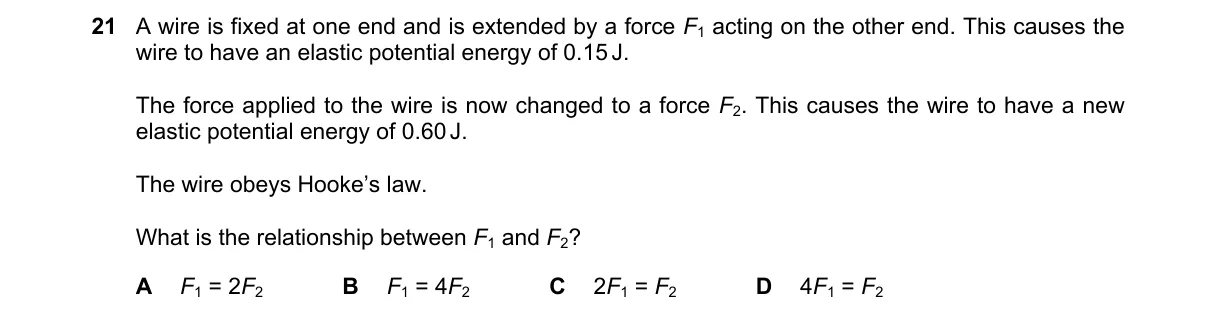
A wire is fixed at one end and is extended by a force F acting on the other end. This causes the wire to have an elastic potential energy of 0.15 J. The force applied to the wire is now changed to a F2. This causes the wire to have a new elastic potential energy of 0.6 J. The wire obeys Hooke's law. What is the relationship between F and F2?
Answer choices
- AF=2F2
- BF=4F2
- CF=F2
- DF=F2
Explanation
Elastic potential energy is proportional to the square of the applied force for Hooke's law.
Steps:
- Elastic potential energy U = (1/2) F^2 / k, where k is the spring constant.
- For the first case, 0.15 = (1/2) F^2 / k.
- For the second case, 0.6 = (1/2) F2^2 / k.
- Divide equations: 0.6 / 0.15 = 4 = (F2 / F)^2, so F2 / F = 2, and F2 = 2F.
Why none of the options match exactly:
- The calculated relationship is F2 = 2F (or F = 0.5 F2), but options A and B reverse the ratio, while C and D ignore the energy difference.
Final answer: F2 = 2F
Topic: Elastic and plastic behaviour
Practice more A Levels Physics (9702) questions on mMCQ.me