A Levels Physics (9702)•9702/12/M/J/24
A Levels Physics (9702) — 9702/12/M/J/24, Question 23
A stationary sound wave is set up between a loudspeaker and a wall. A microphone is connected to a cathode-ray oscilloscope (CRO) and is moved along a line directly between the loudspeaker and the wall. The oscilloscope (CRO) trace of the sound received is shown at a minimum at position X and then rises once again to a maximum at position Y. The distance between X and Y is 30 cm. The speed of sound in air is 300 m s^{-1}. Which diagram could represent the CRO trace of the sound received at 30 m s^{-1}.
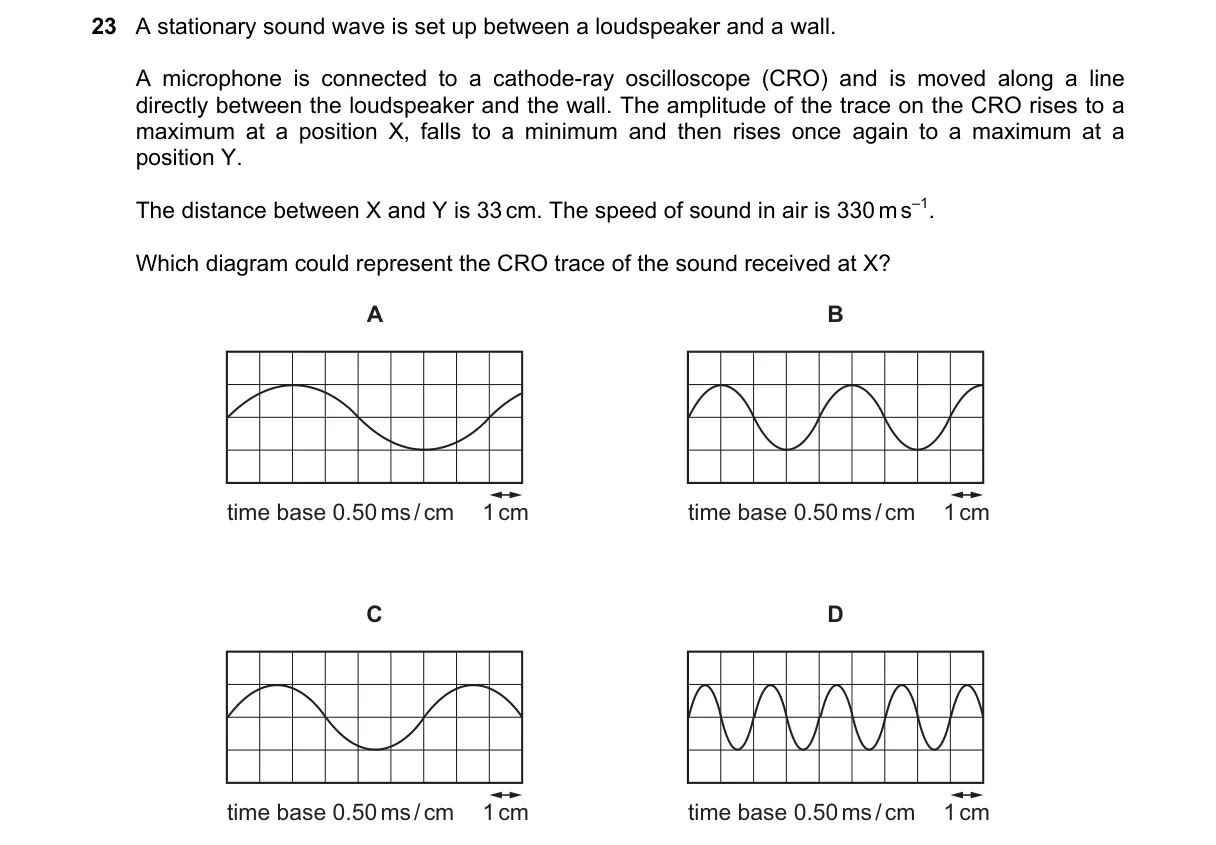
Answer choices
- AOption A
- BOption B
- COption C
- DOption D
Explanation
Standing wave node-to-antinode distance determines wavelength
Steps:
- In a sound standing wave, position X is a displacement node (minimum amplitude), Y is an antinode (maximum amplitude).
- Distance XY = 30 cm = 0.3 m = λ/4, so wavelength λ = 1.2 m.
- With speed v = 300 m/s, frequency f = v/λ = 300 / 1.2 = 250 Hz.
- At reduced speed 30 m/s, new frequency f' = 30 / 1.2 = 25 Hz, producing a lower-frequency sinusoidal trace on CRO.
Why B is correct:
- B shows a low-frequency sine wave, matching the reduced f' = 25 Hz from halved speed (same λ in fixed setup).
Why the others are wrong:
- A: High-frequency wave, implies unchanged or higher speed.
- C: Distorted or clipped waveform, not sinusoidal sound.
- D: Flat or no signal, ignores ongoing wave propagation.
Final answer: B
Topic: Stationary waves
Practice more A Levels Physics (9702) questions on mMCQ.me