A Levels Physics (9702)•9702/12/M/J/24
A Levels Physics (9702) — 9702/12/M/J/24, Question 13
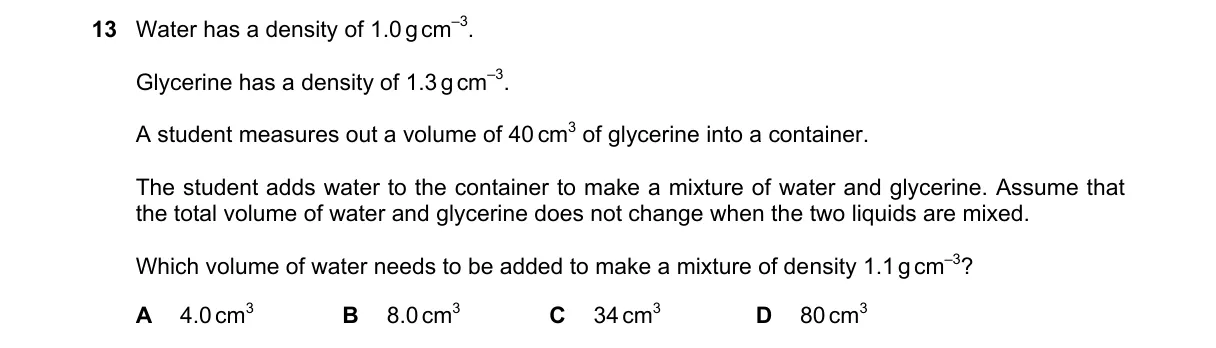
Water has density 1.0 g cm⁻³. Glycerine has density 1.3 g cm⁻³. A student measures out a volume of 40 cm³ of glycerine into a container. The student adds water to the glycerine to make a mixture of water and glycerine. Assume that the total volume of water and glycerine does not change when the two liquids are mixed. Which volume of water needs to be added to make the mixture have density 1.1 g cm⁻³?
Answer choices
- A40 cm³
- B8 cm³
- C34 cm³
- D80 cm³
Explanation
Mixture density calculation
Steps:
- Mass of glycerine: 1.3 g cm⁻³ × 40 cm³ = 52 g
- Let V = volume of water (cm³); mass of water = 1.0 g cm⁻³ × V = V g
- Total mass = 52 + V g; total volume = 40 + V cm³
- Density equation: (52 + V) / (40 + V) = 1.1 → solve: V = 80 cm³
Why D is correct:
- 80 cm³ satisfies the density formula, giving total mass 132 g in 120 cm³ for exactly 1.1 g cm⁻³.
Why the others are wrong:
- A: 40 cm³ yields (52 + 40) / 80 = 1.15 g cm⁻³, higher than 1.1
- B: 8 cm³ yields (52 + 8) / 48 = 1.25 g cm⁻³, much higher
- C: 34 cm³ yields (52 + 34) / 74 ≈ 1.16 g cm⁻³, higher than 1.1
Final answer: D
Topic: Density and pressure
Practice more A Levels Physics (9702) questions on mMCQ.me