A Levels Physics (9702)•9702/11/M/J/24
A Levels Physics (9702) — 9702/11/M/J/24, Question 37
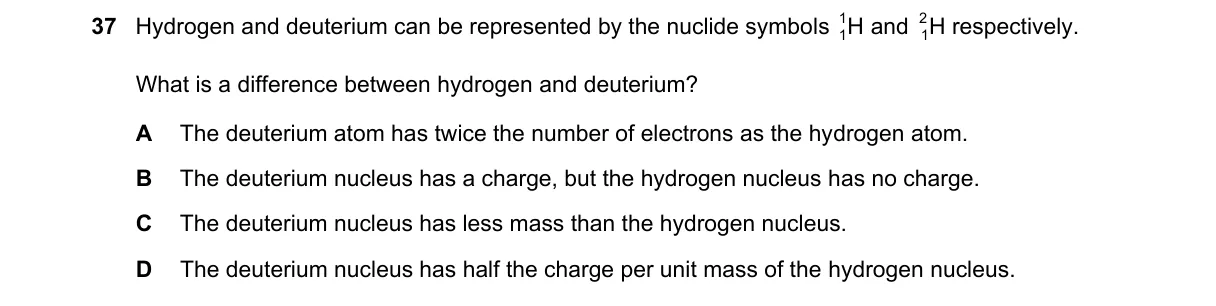
Hydrogen and deuterium can be represented by the nuclide symbols ^1H and ^2H respectively.
Answer choices
- AThe deuterium atom has twice the number of electrons as the hydrogen atom.
- BThe deuterium nucleus has less mass than the hydrogen nucleus.
- CThe deuterium nucleus has a charge, but the hydrogen nucleus has no charge.
- DThe deuterium nucleus has half the charge per mass of the hydrogen nucleus.
Explanation
Isotopes and Nuclear Charge-to-Mass Ratio
Steps:
- ^1H nucleus: 1 proton (charge +1e), mass ≈1 u; ^2H nucleus: 1 proton + 1 neutron (charge +1e), mass ≈2 u.
- Both isotopes have atomic number Z=1, so same nuclear charge of +1e.
- Charge per unit mass for ^1H: +1e / 1 u = +1e/u.
- For ^2H: +1e / 2 u = +0.5e/u, half that of ^1H.
Why D is correct:
- Charge-to-mass ratio is nuclear charge divided by mass number; deuterium's doubled mass halves this ratio relative to hydrogen, per the definition of specific charge in nuclear physics.
Why the others are wrong:
- A: Both neutral atoms have 1 electron each, as electron number equals Z.
- B: Deuterium nucleus mass (2 u) exceeds hydrogen's (1 u) due to extra neutron.
- C: Both nuclei have +1e charge from single proton.
Final answer: D
Topic: Atoms, nuclei and radiation
Practice more A Levels Physics (9702) questions on mMCQ.me