A Levels Physics (9702)•9702/11/M/J/24
A Levels Physics (9702) — 9702/11/M/J/24, Question 19
A plane wave of amplitude A is incident on a surface of area S so that it is perpendicular to the direction of the wave. The amplitude of the wave is increased to 2A and the area of the surface is reduced to S/2. How much energy per unit time reaches this smaller surface?
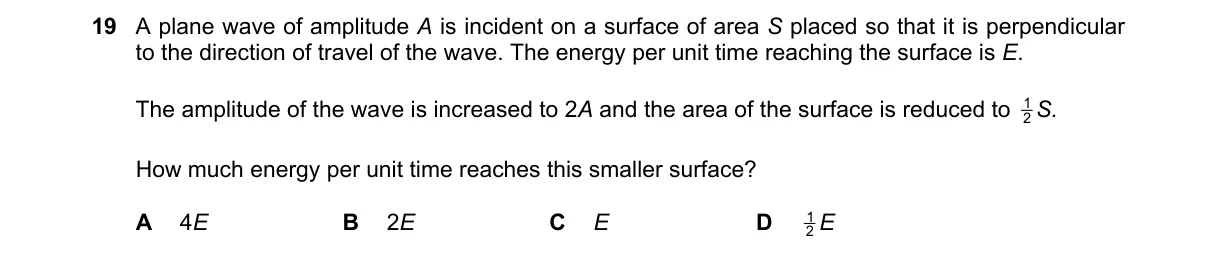
Answer choices
- A4E
- B2E
- CE
- D1/2 E
Explanation
Wave intensity scales with amplitude squared and power with area
Steps:
- Original intensity I ∝ A²; power E = I × S.
- New amplitude 2A gives new intensity I' = (2A)² / A² × I = 4I.
- New area S/2 reduces the area factor by half.
- New power = 4I × (S/2) = 2(I × S) = 2E.
Why B is correct:
- Wave power equals intensity times area; intensity ∝ amplitude², so doubling amplitude quadruples intensity, but halving area halves the power, netting 2E.
Why the others are wrong:
- A: Quadruples intensity but ignores area halving.
- C: Assumes no net change, ignoring both amplitude increase and area reduction.
- D: Considers only area halving, ignoring amplitude effect.
Final answer: B
Topic: Progressive waves
Practice more A Levels Physics (9702) questions on mMCQ.me