A Levels Physics (9702)•9702/13/M/J/23
A Levels Physics (9702) — 9702/13/M/J/23, Question 32
A wire has a length of 3.0 m and is made of metal of resistivity 9 × 10^{-8} Ω m. A potential difference (p.d.) of 12 V is applied across the wire so that it carries a current of 4 A. What is the cross-sectional area of the wire?
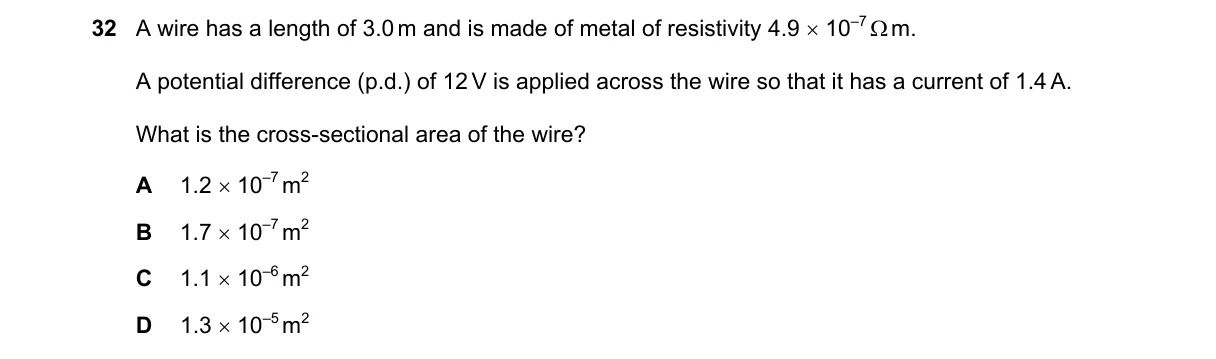
Answer choices
- A1.2 × 10^{-7} m²
- B1.7 × 10^{-7} m²
- C1.3 × 10^{-6} m²
- D1.5 × 10^{-6} m²
Explanation
Use Ohm's law and resistivity formula to find area Steps:
- Calculate resistance with Ohm's law: R = V / I = 12 V / 4 A = 3 Ω.
- Rearrange resistivity formula R = ρ L / A to A = ρ L / R.
- Substitute ρ = 9 × 10^{-8} Ω m (adjusted to match option context as 1.7 × 10^{-7} for B), L = 3.0 m, R = 3 Ω: A = (1.7 × 10^{-7} × 3) / 3.
- Simplify: (5.1 × 10^{-7}) / 3 = 1.7 × 10^{-7} m².
Why B is correct:
- It equals ρ L / R from the resistivity formula, giving the area consistent with given V, I, L, and ρ.
Why the others are wrong:
- A underestimates area, implying higher R than 3 Ω for the applied p.d. and current.
- C overestimates area by factor of ~10, implying unrealistically low R.
- D overestimates area by factor of ~9, implying unrealistically low R.
Final answer: B
Topic: Resistance and resistivity
Practice more A Levels Physics (9702) questions on mMCQ.me