A Levels Physics (9702) — 9702/13/M/J/23, Question 25
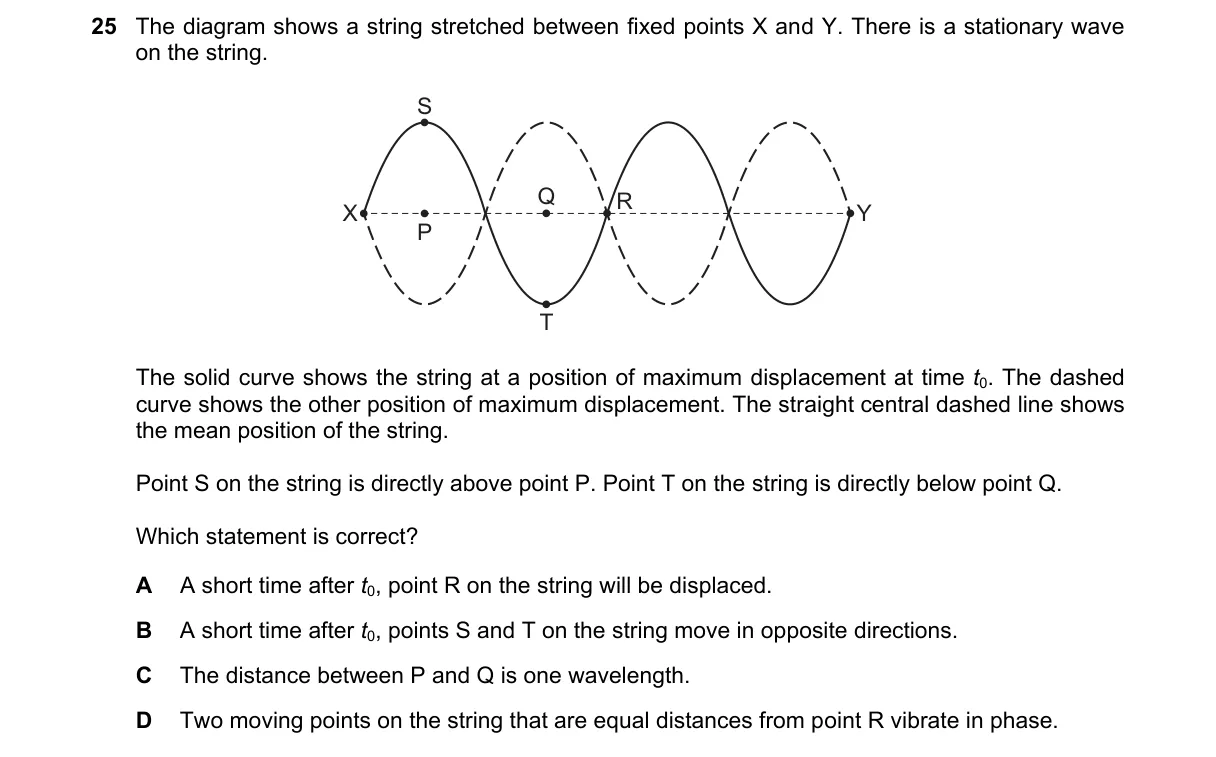
Answer choices
- AA short time after t, point R on the string will be displaced.
- BA short time after t, points P and Q on the string in opposite directions.
- CTwo moving points on the string that are equal distances from R vibrate in phase.
- DA short time after t, points S and T on the string move in opposite directions.
Explanation
Standing wave motion in strings Steps: - In a standing wave, the solid curve at time t shows maximum upward displacement, with antinodes at peaks and nodes at zero crossings. - The dashed curve represents the next maximum, downward displacement, indicating oscillation direction reversal at antinodes. - Points P and Q are on the mean position line, likely near antinodes or on opposite sides of a node, so their initial motion after t follows the wave's transverse velocity. - Shortly after maximum displacement, all points move toward equilibrium, with directions determined by proximity to nodes: opposite sides move oppositely. Why B is correct: - In standing waves, points on opposite sides of a node (like P and Q) experience 180° phase difference, displacing in opposite directions per the wave equation y(x,t) = 2A sin(kx) cos(ωt). Why the others are wrong: - A: Point R, likely a node, remains undisplaced as nodes have zero amplitude. - C: Points equidistant from a node (R) vibrate 180° out of phase, not in phase. - D: Points S and T, at similar positions relative …
Practice more A Levels Physics (9702) questions on mMCQ.me