A Levels Physics (9702)•9702/13/M/J/23
A Levels Physics (9702) — 9702/13/M/J/23, Question 24
A source of plane polarised light is observed through two polarising filters. The filters are positioned so that one filter is rotated clockwise and the other filter is rotated anticlockwise through the same angle. How does the source appear when both filters have been rotated 90° and 180° from their initial positions?
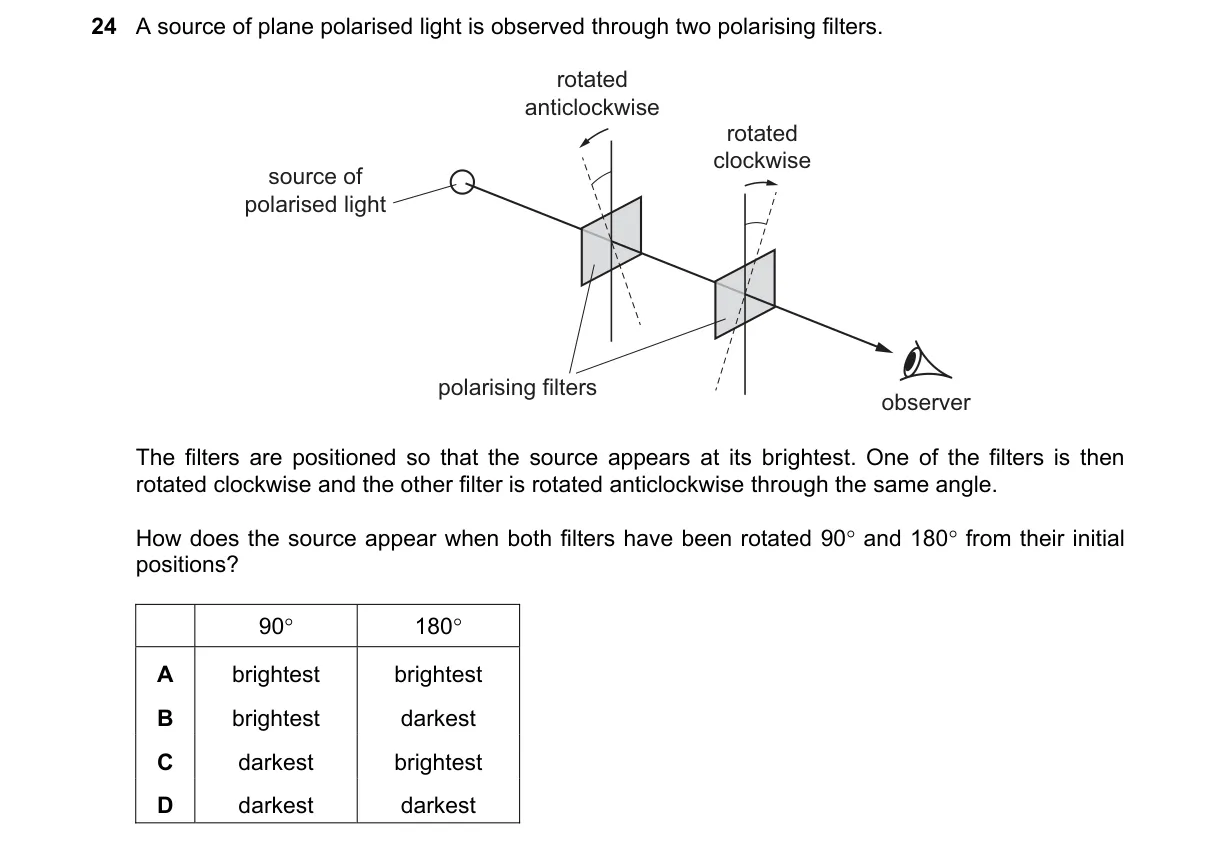
Answer choices
- Abrightest darkest
- Bdarkest brightest
- Cbrightest brightest
- Ddarkest darkest
Explanation
Relative angle between polarizers determines transmission
Steps:
- Initial filter axes parallel (0° relative angle), allowing maximum transmission if aligned with light.
- One filter rotates clockwise by θ, other anticlockwise by θ, creating 2θ relative angle between axes.
- By Malus's law, transmitted intensity ∝ cos²(relative angle) = cos²(2θ).
- At θ=90°, 2θ=180°, cos²(180°)=1, full transmission between filters, brightest.
- At θ=180°, 2θ=360°=0° equivalent, cos²(0°)=1, full transmission between filters, brightest.
Why C is correct:
- Relative angles of 180° and 360° are equivalent to 0° or 180° (parallel axes), yielding cos²=1 per Malus's law for maximum intensity.
Why the others are wrong:
- A: 180° rotation yields brightest, not darkest (cos²(360°)=1).
- B: 90° rotation yields brightest, not darkest (cos²(180°)=1).
- D: Both cases brightest, not darkest.
Final answer: C
Topic: Polarisation
Practice more A Levels Physics (9702) questions on mMCQ.me