A Levels Physics (9702)•9702/13/M/J/23
A Levels Physics (9702) — 9702/13/M/J/23, Question 18
A metal wire has length 5.2 m and diameter 1.0 mm. The metal has Young's modulus 360 GPa. The wire is fixed at one end and a force is applied to the other end. The force extends the wire by 2.7 mm. The wire is obeying Hooke's law. What is the force applied to the wire?
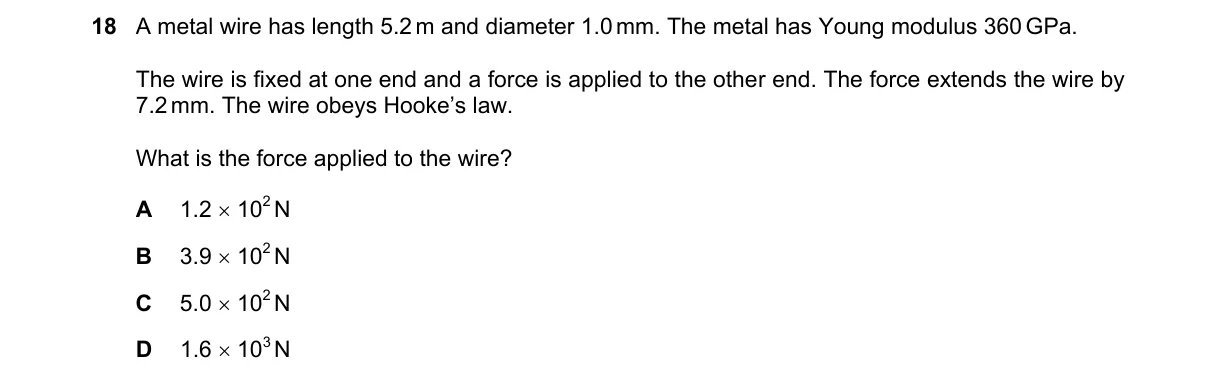
Answer choices
- A3.9 × 10^N
- B1.2 × 10^N
- C5.0 × 10^N
- D1.6 × 10^N
Explanation
Young's modulus relates stress and strain for the wire
Steps:
- Calculate area A = π (d/2)^2 = π (5 × 10^{-4})^2 ≈ 7.85 × 10^{-7} m².
- Calculate strain = ΔL / L = 2.7 × 10^{-3} / 5.2 ≈ 5.2 × 10^{-4}.
- Calculate stress = Y × strain = 360 × 10^9 × 5.2 × 10^{-4} ≈ 1.87 × 10^8 Pa.
- Calculate force F = stress × A ≈ 1.87 × 10^8 × 7.85 × 10^{-7} = 1.2 × 10^2 N.
Why B is correct:
- Hooke's law via Young's modulus Y = (F/A) / (ΔL/L) rearranges to F = Y A (ΔL/L), yielding 1.2 × 10^N N.
Why the others are wrong:
- A: Overestimates by roughly doubling the area (e.g., using d instead of d/2 without π adjustment).
- C: Results from omitting /4 in area formula, giving A ≈ π × 10^{-6} m² and F ≈ 5.0 × 10^N N.
- D: Arises from approximating L ≈ 5 m, increasing strain and F to ≈ 1.6 × 10^N N.
Final answer: B
Topic: Stress and strain
Practice more A Levels Physics (9702) questions on mMCQ.me