A Levels Physics (9702)•9702/13/M/J/23
A Levels Physics (9702) — 9702/13/M/J/23, Question 15
An airport has a mechanical system for moving suitcases. The system uses a horizontal conveyor belt, a sloping conveyor belt and a frictionless slide. A suitcase is moved around the airport using this system. Resistive forces opposing the motion of the suitcase are negligible. For which movement of the suitcase is the net work done on the suitcase greatest?
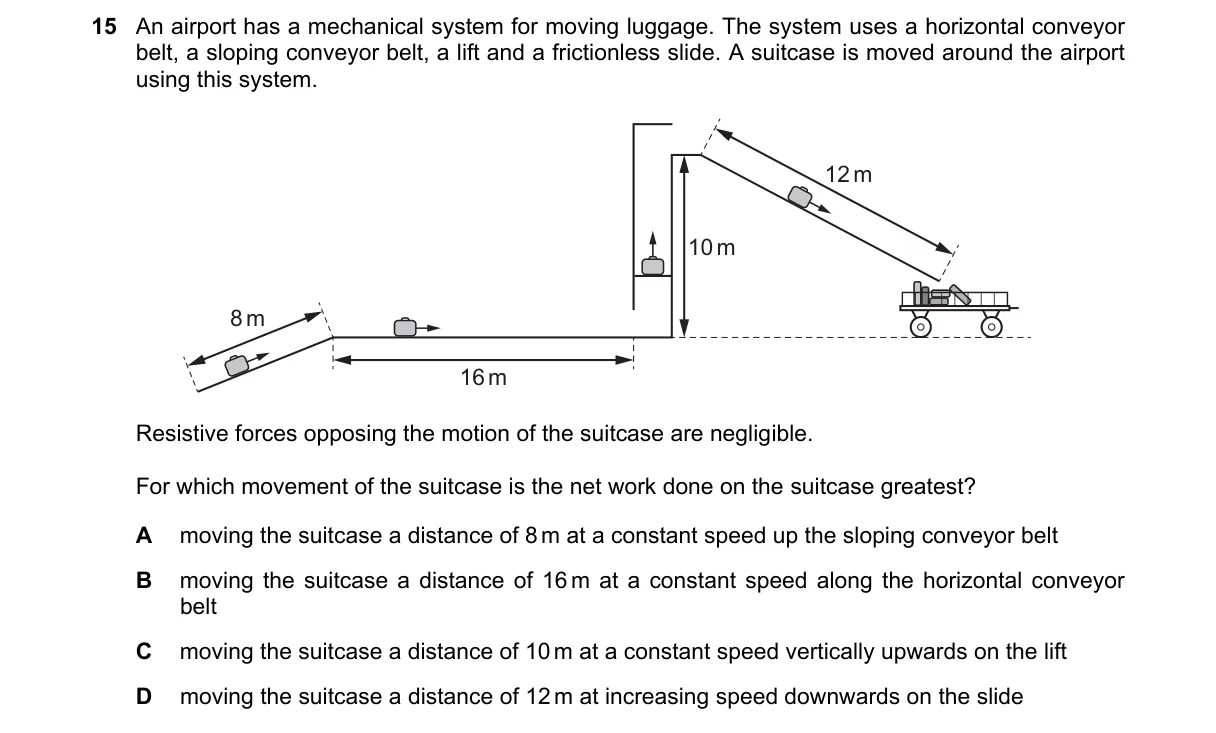
Answer choices
- Amoving the suitcase a distance of 8m at a constant speed up the sloping conveyor belt
- Bmoving the suitcase a distance of 10m at a constant speed vertically upwards on the lift
- Cmoving the suitcase a distance of 12m at increasing speed downwards on the slide
- Dmoving the suitcase a distance of 8m at a constant speed along the horizontal conveyor belt
Explanation
Net work equals change in kinetic energy
Steps:
- Apply work-energy theorem: net work on suitcase = ΔKE.
- For constant speed (A, B, D), ΔKE = 0, so net work = 0.
- For C, increasing speed on frictionless slide means ΔKE > 0, so net work > 0.
- Distances irrelevant since net work depends on speed change, not path length.
Why C is correct:
- Frictionless slide allows gravity to accelerate suitcase downward, increasing KE per work-energy theorem (W_net = ΔKE > 0).
Why the others are wrong:
- A: Constant speed up slope means net force = 0, so W_net = 0.
- B: Constant vertical speed means net force = 0, so W_net = 0.
- D: Constant horizontal speed with negligible resistance means net force = 0, so W_net = 0.
Final answer: C
Topic: Gravitational potential energy and kinetic energy
Practice more A Levels Physics (9702) questions on mMCQ.me